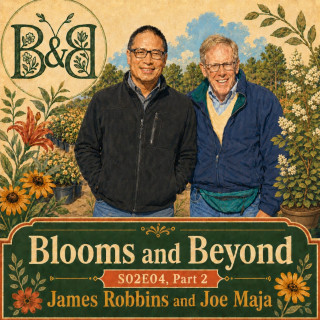
Drones Take Flight in the Nursery: RFID, Real-Time Inventory, and the Road Ahead (Part 2)
S02:E04

Drones Take Flight in the Nursery: RFID, Real-Time Inventory, and the Road Ahead (Part 2)

Episode description

Episode Description

A tag you never have to look at. That’s the promise behind the RFID work Dr. Jim Robbins and Dr. Joe Maja have been chasing for the better part of two decades — a way to walk past a block of containers, or fly over it, and know exactly what’s there without picking up a single pot. In Part 2 of this special two-parter, Ping picks the conversation back up where it left off, this time digging into the applied research: how passive UHF tags work, what a drone-mounted reader can do that a barcode scanner can’t, and why the real payoff isn’t counting plants — it’s tracing them from propagation all the way to the checkout line.

Joe walks through the practical side a grower actually cares about: traditional tags versus RFID, where to start (small, with a single block or a high-value crop), how to pick a vendor who understands that moisture and container materials change everything, and the honest math on cost. Jim fills in the origin story and the “lower step” version of the system for nurseries that aren’t ready to tag every plant. Along the way the two of them land on the lessons that only show up after twenty years in the field — that simple beats sophisticated, that reliability matters more than precision, and that the projects that actually work are the ones where engineers, horticulturists, and growers are all in the room.

Then they look down the road: integrated systems where drones, RFID, robots, and AI finally talk to each other, a realistic adoption forecast, and a warm closing on why collaboration — the kind that built this whole project — is the thing worth betting on. Recorded with Joe joining live from Japan.

Listen Time: 29:18 Follow Along with the Transcript

In This Episode

Guests

  • Dr. James “Jim” Robbins — Extension Specialist and Professor (retired), University of Arkansas Division of Agriculture. Decades of nursery-production research and a long-running partnership with Joe on automating inventory.
  • Dr. Joe Maja — Director, Center for Applied AI for Sustainable Agriculture, South Carolina State University. Engineer specializing in drones, RFID, dashboards, and the data pipelines that connect them. Joined this recording from Japan.

Main Topics

  • Welcome back and a recap of Part 1 (00:00)
  • Inside the RFID inventory project: the full-system vision from canning to checkout (00:57)
  • The technical side: passive UHF tags, read range, and the data pipeline (06:07)
  • RFID vs. traditional tags — why switch, how to start, and what it costs (07:30)
  • Twenty-plus years of lessons: what works and what can be improved (12:04)
  • How grower interest has shifted, and the role of labor (14:58)
  • Where growers can learn more (16:31)
  • What’s next: integrated systems and an adoption forecast (19:11)
  • Final thoughts, advice for students, and goodbyes (23:46)

Key Highlights

  • RFID’s core advantage over a barcode is that it doesn’t need line of sight — you can read tags in bulk, wirelessly, hundreds or thousands in seconds.
  • The vision isn’t just a headcount. A tag applied at canning can follow a plant onto the truck (touchless inventory), to the garden center, and through checkout — even into a point-of-sale system.
  • Not every nursery needs a drone. Jim describes a “lower step” version: tag a block, link it to the production database, and read it with a handheld gun from a truck window.
  • After 20+ years, the durable lessons are about people and conditions, not gadgets: simple wins, reliability beats precision, and ag is a brutal environment for technology.
  • Joe’s realistic forecast: roughly 50–70% adoption across the industry over the next 15–20 years, with simple imaging arriving first and integrated systems taking longer.

Key Quotes

“The advantage is that it doesn’t require line of, line of sight. And if we could attach the plant… And then just fly over the top and simply count these things, we thought this was brilliant.” — Jim Robbins (02:11)

“Instead of scanning one plant at a time, you can scan hundreds or even thousands of plants in a matter of seconds.” — Joe Maja (09:15)

“It’s not just about inventory, it’s about connecting the entire life cycle.” — Joe Maja (12:12)

“We’ve also seen that reliability is often more important than precision. A system that works consistently, even if it’s not perfect, is more valuable than one that’s highly precise but unreliable.” — Joe Maja (13:48)

“The interest has clearly shifted from ‘What is this?’ to ‘How do I use this?’ And that’s usually a strong sign that the technology is moving toward mainstream adoption.” — Joe Maja (16:16)

“You guys set a great example of how collaboration works and how collaboration matters.” — Ping Yu (27:39)

Educational Highlights

  • RFID (Radio-Frequency Identification): A wireless way to read identifying tags without line of sight, in bulk. The opposite of a barcode, which must be physically seen and scanned one at a time.
  • Passive UHF RFID tags: The type used in this project. “Passive” means the tag has no internal power source — it draws energy from the reader — which keeps it cost-effective and practical for large-scale deployment. UHF (ultra-high frequency) supports the read ranges useful in a nursery.
  • Read range factors: How far a tag can be read depends on reader configuration, tag orientation, and environmental conditions — and on a drone, that directly shapes flight planning: altitude, speed, and coverage pattern.
  • Touchless inventory: Reading tags as product moves — onto a truck, off at a garden center, out the door at checkout — so an accurate count happens automatically, much like cashier-less retail stores.
  • Traceability: Following a plant’s full life cycle from propagation to retail. RFID provides the data foundation for supply-chain transparency and data-driven decisions.
  • Dashboards / data pipeline: Reading tags is useless unless the data becomes usable. Tag reads flow to a backend system that processes and visualizes them, turning raw data into something a grower can act on.
  • Part 107: The FAA certification framework for commercial small-drone operation — one of the things training programs and workshops help growers understand.

Resources & Links

  • Website: bandbpod.com
  • Dr. Joe Maja’s work: Search his name with “South Carolina State University” or on Google Scholar to reach his university profile and research publications. A Center for Applied AI for Sustainable Agriculture website highlighting projects and outreach is in development.
  • University extension programs: Land-grant institutions such as UGA, Clemson, and South Carolina State publish free, grower-focused fact sheets, guides, and case studies on drone applications.
  • Training & events: University and private workshops, structured courses, and industry conferences and trade shows are good ways to understand regulations (e.g., Part 107) and see the technology in action.
  • A peer-reviewed publication on RFID read range from the project was referenced — see Dr. Maja’s Google Scholar page.

About Blooms and Beyond

Blooms and Beyond explores plant history, culture, and management through the lens of science. Whether you’re a commercial grower seeking practical solutions, a student exploring careers in horticulture, or simply someone who loves plants and their stories, there’s something here for you. Hosted by Dr. Ping Yu of the University of Georgia, each episode features interviews with experts who share enchanting stories, cutting-edge research, and practical wisdom from the world of horticulture.

Your benefit: After each episode, commercial growers will have at least one useful tip for their operation, and plant enthusiasts will have an interesting fact to share. That’s how we spread plant power to more people and make our environment a little better.

Credits

Host: Dr. Ping Yu Producer: Rich Braman Guests: Dr. James Robbins (University of Arkansas Division of Agriculture, retired); Dr. Joe Maja (Center for Applied AI for Sustainable Agriculture, South Carolina State University)

Episode Release Date: June 28, 2026 Episode Length: 29:18

“Till next time, stay healthy and go plants!” 🌱