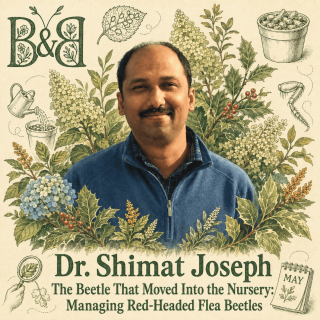
S02:E07
Growers spent years assuming the red-headed flea beetle flew in from the field edge. Dr. Shimat Joseph went looking for it out there and found almost nothing. When his lab sampled the landscapes around Georgia container nurseries, the beetle simply was not present, and nobody was reporting it as a landscape problem either. The pest was already home. The well-drained pine bark container that growers built for their plants turns out to be the exact combination of drainage and moisture retention the larvae need, which means the nursery is not being invaded so much as hosting a permanent resident.
Dr. Ping Yu walks Dr. Joseph through the whole animal in this episode. Why the name has three separate parts to it, red for the tinge on the forehead, flea for the powerful hind leg that lets it jump, beetle for the chewing mouthparts. What the damage actually looks like as adults rasp the tissue between the veins until the leaf shot-holes, skeletonizes, and drops. Why a plant that would be perfectly healthy in a garden is worthless in a nursery, because ornamental stock sells on looks. And how the whole cycle, egg to adult, can turn over in about a month at 80 to 85 degrees.
What makes the conversation unusual is how often the answer is “we don’t know yet.” Sex ratio, eggs per female, how long adults live, how many times they mate: Dr. Joseph declines to guess on all of it, and explains why guessing would be worse than admitting the gap. There is still plenty here for growers to act on, including which products his trials screened as effective, why an April drench or granule application can protect a block for months, and why protecting one block just pushes the beetles onto the next one over.
Listen Time: 42:17 Follow Along with the Prose Transcript
Dr. Shimat Joseph, Associate Professor, Department of Entomology, University of Georgia (Griffin campus). Dr. Joseph works on insect problems in turf and ornamental systems, in nurseries and landscapes. He joined UGA in 2017, and red-headed flea beetle is the main focus of his nursery work. His lab publishes applied research and a blog for the turf and ornamental industries.
The industry assumption was backwards. The long-held view was that beetles flew in from surrounding landscape, fed on weeds along the field edges, and worked their way in. Dr. Joseph’s sampling found none in the landscapes at all, and no reports of the beetle as a landscape pest. His conclusion is that the major driver is the nursery itself.
The container is a purpose-built habitat. Larvae need moisture but not standing water. Pine bark in a nursery container drains fast and still retains moisture, which is precisely the balance the beetle needs. Growers optimized their substrate for plant roots and accidentally optimized it for this pest too.
Only one life stage costs money. Larvae feed on roots in the container, but Dr. Joseph’s team has found no evidence of economic root damage. Adults are the destructive stage, because ornamental crops are sold on appearance and shot-holed foliage does not sell.
Timing cannot be modeled the usual way. Generations three and four overlap so heavily that they cannot be told apart, and different host plants speed up or slow down development. That rules out the growing degree day approach that works for many other pests.
Protecting one block moves the problem. Spray a block of hydrangea and that block is protected, but the beetles get pushed onto neighboring plants they would not normally choose. Understanding that movement is an active research question in the lab right now.
“And I think the containers in the nurseries are providing exactly that, and they just love it and they just stay there and continue their population.” Dr. Shimat Joseph, 15:22
“We can guess it, but I think the guessing may not be right here. So that’s why I’m not giving a number to it.” Dr. Shimat Joseph, 25:09
“But eventually what happens is that they’re, they’re– we are pushing them to other plants and, uh, where they normally won’t go.” Dr. Shimat Joseph, 34:43
“It is good enough that different growers can strategize that according to their marketing window.” Dr. Shimat Joseph, 33:41
“There’s a lot of going on behind the scene where the plant is growing, and they have all those interactions with the pest, and they have to combat the whole challenges to be able to come to your door.” Dr. Ping Yu, 38:46
Systena frontalis is the scientific name for the red-headed flea beetle. It is not spoken in the episode, and is included here so listeners searching for the research have the right term.
Chrysomelidae is the beetle family Dr. Joseph names in the episode, the leaf beetles. It is a large and varied group, and Japanese beetle belongs to it as well. Red-headed flea beetle is a leaf feeder within that family, and while it can feed on flowers, no flower damage has been observed in Dr. Joseph’s work.
Three parts to one name. Red for the reddish tinge on the forehead. Flea for the enlarged hind leg that powers the jump. Beetle for the hardened forewings and the biting, chewing mouthparts.
Chewing versus piercing mouthparts. Beetles crush and ingest leaf tissue with mandibles. Contrast that with a mosquito, whose mouthparts form a straw containing six needles, called stylets, used to inject saliva and digest tissue before drawing it up. That difference in mouthparts is what separates the damage signatures growers see in the field.
Shot hole describes the small perforations left after adults feed repeatedly on the same leaf area. Tissue is rasped away, the fed area sinks, disintegrates, and opens.
Skeletonization is the end state. Adults feed on the tissue between the veins, and with enough feeding only the vein network remains before the leaf drops.
Instar means a stage between molts. Insects grow inside a rigid exoskeleton and cannot expand gradually the way we do, so they shed and rebuild. Dr. Joseph’s team believes red-headed flea beetle passes through about three larval instars, though the number is not confirmed.
Molting is that shedding process. Dr. Joseph corrects himself on air from “eclosion” to “molting,” a useful distinction: eclosion refers to emergence, typically from the egg or the pupa.
Holometabolous describes complete metamorphosis, where the larva looks nothing like the adult and reorganizes entirely during a pupal resting stage. Monarch butterfly is the familiar example Dr. Joseph reaches for.
Phenology is the study of the timing of biological events across a season, which is what Dr. Joseph’s graduate student is mapping for this pest.
The numbers stated in the episode: eggs laid from the surface down to about 10 centimeters deep, roughly three weeks as larvae, a couple of weeks as pupae, about six days for a new adult to feed and mate, and about one month for the full egg-to-adult cycle at 80 to 85 degrees Fahrenheit. Cooler weather stretches all of it out.
Endosymbionts are microorganisms living inside an insect, such as specific gut bacteria, that can skew the sex ratio of a population. Dr. Joseph raises them as a possible explanation for sex ratio questions his lab has not yet studied in this beetle.
Foliar spray treats the leaf surface and targets adults. Drench applies product to the growing medium, and granules release it into the container over time. Drench and granule applications made early, around April, can leave residues that stop adults feeding for multiple months.
Multi-pronged is Dr. Joseph’s own framing. A single foliar spray on a single crop will not solve this, because adults simply move to another block and complete a generation there.
Dr. Joseph names four chemistries. What follows is current label and registration context, verified after recording, so growers can act on it correctly. This is background, not a recommendation. The label is the law, and product registration, rates, sites, and restrictions must be confirmed for your state before any application.
| Named on air | Active ingredient | Notes verified after recording | |—|—|—| | Neonicotinoid spray, drench, or granule | Class of chemistry, IRAC Group 4A | Dr. Joseph describes this as the option that “really works” as an early-season drench or granule. Neonicotinoid use in ornamentals carries pollinator-related label restrictions that vary by product. | | Sarisa | Cyclaniliprole, IRAC Group 28 | OHP product for greenhouse and nursery ornamental stock. Flea beetles appear on the labeled pest list, and drench application is included on the label. | | XXpire WG | Sulfoxaflor plus spinetoram, IRAC Groups 4C and 5 | Corteva product labeled for herbaceous and woody ornamentals in greenhouses and nurseries. The labeled pest list names elm leaf, viburnum leaf, and willow leaf beetles, but does not specifically list flea beetles. Dr. Joseph’s mention reflects what his screening trials found, which is not the same thing as a label claim. | | Plinazolin | Isocycloseram | Described on air as “on the pipeline.” That has since changed. EPA announced final registration of isocycloseram on November 20, 2025, covering agricultural crops, turf and ornamentals, and various commercial and residential sites. |
Resistance management. The IRAC group numbers above matter for rotation. Alternating products that share a group does not slow resistance, and this pest gets hit repeatedly across four overlapping generations in a season.
Blooms and Beyond explores plant history, culture, and management through the lens of science. Whether you’re a commercial grower seeking practical solutions, a student exploring careers in horticulture, or simply someone who loves plants and their stories, there’s something here for you. Hosted by Dr. Ping Yu of the University of Georgia, each episode features interviews with experts who share enchanting stories, cutting-edge research, and practical wisdom from the world of horticulture.
Your benefit: After each episode, commercial growers will have at least one useful tip for their operation, and plant enthusiasts will have an interesting fact to share. That’s how we spread plant power to more people and make our environment a little better.
Host: Dr. Ping Yu Producer: Rich Braman Guest: Dr. Shimat Joseph, Associate Professor, Department of Entomology, University of Georgia
Episode Release Date: August 2, 2026 Episode Length: 42:17
“Till next time, stay healthy and go plants!” 🌱