0:00Welcome to Blooms and Beyond
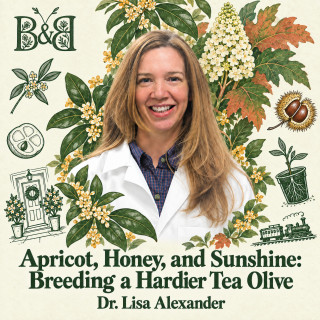
Donna Fare, a former ARS researcher, had Lisa Alexander smell a branch of osmanthus. The words Lisa reaches for to describe that scent became the title of this episode: apricot, honey, and sunshine. Lisa is a research geneticist at the US National Arboretum, part of the USDA Agricultural Research Service, and she breeds hydrangeas, tea olives and other woody ornamentals. For Ping, the smell of Osmanthus fragrans means home. China has been cultivating the species for over 2,000 years.
So why hasn’t tea olive gone further in American markets? Lisa and Ping keep landing on the same reasons. Most Osmanthus fragrans germplasm is in another country, and imported plants sometimes turn out to be all males. Every cross gives exactly one seed, because only one ovule in the four-chambered ovary is ever fertilized, and that seed takes six months to germinate when it germinates at all. Growers mostly propagate from cuttings, and Lisa’s own team is pleased with 50% rooting. Her crosses from 2018 are only now in their third year of field evaluation. From cross to a market-ready tree, she says, is seven to ten years.
Lisa’s program works on those problems from several directions: pre-breeding with microscopy and flow cytometry, open-pollinated seed sorted to its parents with molecular markers, and a firm rule that nothing gets released unless growers can propagate it. Then she describes the plant that could turn the tide, an orange osmanthus that grows through Zone 6, and her dream of a catalog photo showing a front door at Christmas with a blooming Osmanthus fragrans in a pot on each side. The last section stays at the National Arboretum, with how researchers find plants through the National Plant Germplasm System and why USDA wants its collections shared.
Listen Time: 52:55 Follow Along with the Transcript
Dr. Lisa Alexander, Research Geneticist, US National Arboretum, USDA Agricultural Research Service (Floral and Nursery Plants Research Unit). She runs a breeding and genetics program for ornamental landscape plants. Hydrangea is her most active program, oakleaf hydrangea is one of her favorite plants, and tea olive is her other main interest. She also grows fringe tree, an osmanthus relative, and has evaluations and breeding under way for incense cedar and manzanita. Her tea olive trials are in McMinnville, Tennessee. She grew up in the Ridge and Valley of East Tennessee, earned an undergraduate degree in biology, and found plant breeding on a research program with a chestnut breeder. Her background is mainly in forestry.
Host: Dr. Ping Yu, UGA Department of Horticulture
“Apricot, honey, and sunshine. It’s like nothing else.” Dr. Lisa Alexander, on the scent of osmanthus (7:34)
“it didn’t just wipe out a tree, it wiped out an entire way of life.” Dr. Lisa Alexander, on chestnut blight in the eastern US (5:39)
“And with anything, you know, it only takes one amazing plant to turn the tide.” Dr. Lisa Alexander (41:04)
“It says the people who plant the tree, and then the next generation will come in and enjoy the shade.” Dr. Ping Yu (46:20)
“We want to be a node of distribution and not, like, a silo of collection.” Dr. Lisa Alexander, on sharing USDA plant material (50:01)
Tea olive and its relatives. Osmanthus fragrans is native to China, where it grows as an understory tree in temperate forests. Lisa crosses it with more cold-hardy species, mainly Osmanthus armatus, Osmanthus heterophyllus and cultivars of Osmanthus × fortunei, aiming to recover three traits of fragrans: the upright tree form, the flower fragrance, and the smooth leaf. Many osmanthus cultivars have a holly-shaped leaf, which is less friendly in a garden. Fringe tree is an osmanthus relative.
The four osmanthus groups. On air, Ping describes Sijigui as the group that can bloom through the year when conditions favor it, and says the other three groups bloom only in fall. Lisa finds the four categories confusing even as an osmanthus breeder, and she points to the traits underneath them: flower color, from creamy white through light yellow to bright orange; flower form, from flowers appressed to the stem to longer, more pendulant ones; and bloom time. For the group names, Ping’s UGA Extension Circular 1363, Propagating Sweet Tea Olive (Osmanthus fragrans), written with Yulong Chen, lists Yingui (Albus) with white to pale yellow flowers in autumn, Jingui (Luteus) with yellow flowers in autumn, Dangui (Aurantiacus) with orange flowers in autumn, and Sijigui (Asiaticus) with pale yellow to yellow flowers several times from fall to spring.
Apical dominance. An understory osmanthus is content as a multi-stem shrub. In the presence of light, the leading shoot takes over and the plant shoots up toward it. Some are more shrubby than others, but Lisa says every one of them will train up to tree form or stay a shrub, depending on how you want it shaped.
Heterozygous, outcrossing crops. Osmanthus does not inbreed, so each plant carries a lot of genetic diversity. Cross two medium-sized parents and the seedlings range from a tiny dwarf to a giant tree. The same biology makes it hard to build the F2 populations a geneticist normally uses to tie a trait to a gene (37:38).
Pre-breeding. The work before the crosses that count. Lisa uses flow cytometry to make sure parents have the same genome size, and pollen tube work to learn whether a plant is self-fertile, whether flowers need to be emasculated and bagged, and whether one species’ pollen will take on another.
Parentage reconstruction. Collect open-pollinated seed, extract DNA, and let markers identify the parents. Lisa uses microsatellite markers for this. They are not the newest technology, but they are reliable and affordable enough to run in her own lab every season on each batch of seedlings.
Cold stratification. Temperate species such as Osmanthus heterophyllus need a cold period before their seed will germinate, and Osmanthus fragrans does not. Seed germination work has to be species-specific, which leaves an open question for every hybrid seed: does it need stratification or not?
Semi-hardwood cuttings and grafting. Semi-hardwood cuttings are the most popular way to propagate osmanthus cultivars, with problems in both take and survival of rooted cuttings. A few specialty operations graft, and grafting needs seedling rootstocks.
What a traditional breeder means. Lisa calls herself a traditional plant breeder because she thinks in population-level methods such as recurrent selection and backcross breeding. Most of her tea olive work is “pollen to pistil, get the seed, grow out the seed and look at it.” She is adding controlled-environment testing for cold hardiness, so that screening is not only a matter of whether a plant dies in the field.
Genome-enabled breeding. Through Breeding Insights, ARS aims to give all the crops it breeds the kind of technology-based support the big crops have. For a breeder of non-model woody crops, Lisa says, that is a change from living on the technology crumbs that come down from other species.
The National Plant Germplasm System. The first place a researcher should look for a plant. Its GRIN website shows which osmanthus species, seed especially, the system holds. After that, a researcher who reads that a scientist has trialed a set of plants can reach out, and USDA scientists share material under agreements such as a plant evaluation agreement or a material transfer research agreement.
Blooms and Beyond explores plant history, culture, and management through the lens of science. Whether you’re a commercial grower seeking practical solutions, a student exploring careers in horticulture, or simply someone who loves plants and their stories, there’s something here for you. Hosted by Dr. Ping Yu of the University of Georgia, each episode features interviews with experts who share enchanting stories, cutting-edge research, and practical wisdom from the world of horticulture.
Your benefit: After each episode, commercial growers will have at least one useful tip for their operation, and plant enthusiasts will have an interesting fact to share. That’s how we spread plant power to more people and make our environment a little better.
Host: Dr. Ping Yu Producer: Rich Braman Guest: Dr. Lisa Alexander, Research Geneticist, US National Arboretum, USDA Agricultural Research Service
Episode Release Date: September 13, 2026 Episode Length: 52:55
“Till next time, stay healthy and go plants!” 🌱