Ping Yu: Hello everyone,
Download transcript (.srt)
0:05
0:06
0:08
0:11
0:11
0:12
0:14
0:15
0:15
0:16
0:16
0:23
0:26
0:29
0:32
0:34
0:35
0:42
0:43
0:44
0:46
0:47
0:51
0:59
1:02
1:05
1:08
1:10
1:16
1:18
1:20
1:21
1:28
1:34
1:38
1:48
1:49
1:55
2:02
2:03
2:04
2:08
2:10
2:11
2:15
2:18
2:19
2:22
2:26
2:29
2:30
2:32
2:34
2:36
2:38
2:40
2:45
2:48
2:53
3:00
3:03
3:05
3:12
3:13
3:15
3:18
3:24
3:26
3:27
3:32
3:33
3:40
3:40
3:42
3:43
3:48
3:55
4:00
4:06
4:09
4:11
4:11
4:13
4:21
4:25
4:25
4:28
4:29
4:35
4:39
4:49
4:55
4:59
5:00
5:04
5:06
5:10
5:15
5:18
5:19
5:27
5:29
5:31
5:39
5:43
5:44
5:49
5:55
5:58
6:00
6:01
6:02
6:03
6:04
6:06
6:08
6:11
6:12
6:14
6:19
6:23
6:24
6:26
6:27
6:34
6:43
6:45
6:45
6:45
6:51
6:53
6:54
6:55
6:58
7:01
7:05
7:09
7:10
7:13
7:14
7:16
7:17
7:20
7:22
7:23
7:23
7:31
7:32
7:32
7:34
7:36
7:40
7:47
7:48
7:50
7:52
7:58
8:00
8:03
8:06
8:08
8:11
8:12
8:13
8:14
8:21
8:23
8:26
8:30
8:33
8:34
8:37
8:49
8:50
8:56
8:57
9:05
9:06
9:07
9:10
9:15
9:17
9:20
9:22
9:24
9:32
9:41
9:44
9:50
9:51
9:53
9:55
9:57
10:00
10:04
10:05
10:08
10:12
10:14
10:17
10:21
10:30
10:31
10:38
10:41
10:45
10:48
10:51
10:55
11:01
11:11
11:15
11:17
11:21
11:26
11:28
11:31
11:32
11:34
11:45
11:47
11:55
11:57
12:04
12:06
12:07
12:09
12:10
12:11
12:16
12:16
12:17
12:18
12:19
12:19
12:21
12:29
12:32
12:36
12:47
12:52
12:56
12:57
12:57
12:59
13:00
13:12
13:14
13:15
13:18
13:21
13:23
13:24
13:27
13:36
13:47
13:49
13:58
14:00
14:02
14:03
14:04
14:05
14:06
14:11
14:24
14:28
14:32
14:33
14:35
14:39
14:43
14:44
14:51
14:56
15:09
15:11
15:13
15:18
15:22
15:24
15:26
15:27
15:29
15:30
15:34
15:39
15:41
15:45
15:48
15:52
15:56
16:01
16:07
16:10
16:16
16:22
16:25
16:27
16:30
16:33
16:42
16:54
16:57
17:01
17:04
17:05
17:18
17:30
17:42
17:43
17:44
17:51
17:55
17:59
18:01
18:02
18:06
18:09
18:13
18:14
18:17
18:18
18:23
18:27
18:35
18:40
18:42
18:53
18:54
18:56
18:59
19:01
19:03
19:08
19:11
19:13
19:14
19:16
19:24
19:28
19:33
19:40
19:42
19:46
19:47
19:54
20:01
20:01
20:03
20:08
20:09
20:10
20:12
20:12
20:13
20:18
20:19
20:23
20:28
20:29
20:34
20:39
20:44
20:50
20:52
20:55
20:58
20:59
21:02
21:05
21:07
21:13
21:17
21:20
21:22
21:24
21:26
21:30
21:34
21:37
21:44
21:46
21:49
21:52
21:55
22:00
22:01
22:01
22:02
22:12
22:22
22:27
22:27
22:29
22:34
22:35
22:38
22:38
22:38
22:46
22:48
22:49
22:52
22:54
22:55
22:56
23:04
23:08
23:11
23:12
23:17
23:23
23:26
23:29
23:33
23:34
23:40
23:44
23:49
23:53
23:57
24:03
24:08
24:09
24:19
24:21
24:26
24:31
24:34
24:36
24:38
25:01
25:05
25:11
25:15
25:17
25:20
25:24
25:30
25:31
25:35
25:37
25:40
25:47
25:48
25:54
25:55
25:59
26:03
26:05
26:07
26:10
26:19
26:26
26:27
26:31
26:33
26:34
26:37
26:52
26:59
27:00
27:02
27:05
27:08
27:09
27:13
27:15
27:17
27:21
27:23
27:25
27:28
27:31
27:34
27:36
27:36
27:41
27:41
27:43
27:44
27:46
27:53
27:54
28:12
28:14
28:17
28:24
28:39
28:40
28:45
28:50
28:54
28:56
29:00
29:04
29:12
29:15
29:16
29:17
29:19
29:22
29:26
29:32
29:33
29:34
29:35
29:36
29:41
29:46
29:49
29:52
29:59
30:03
30:04
30:10
30:14
30:19
30:22
30:27
30:27
30:28
30:34
30:45
30:48
30:49
30:50
30:53
30:54
30:55
30:56
30:56
30:57
30:59
31:01
31:05
31:06
31:09
31:12
31:16
31:20
31:33
31:37
31:44
31:47
31:48
31:49
31:51
32:09
32:13
32:14
32:19
32:19
32:23
32:24
32:26
32:30
32:34
32:46
32:53
32:55
32:56
33:06
33:12
33:16
33:21
33:26
33:29
33:35
33:39
33:40
33:42
33:50
34:01
34:05
34:07
34:12
34:16
34:17
34:19
34:22
34:37
34:38
34:38
34:41
34:42
34:48
34:54
34:59
34:59
35:02
35:05
35:05
35:15
35:23
35:24
35:26
35:27
35:31
35:33
35:38
35:40
35:41
35:45
35:46
35:47
35:49
35:54
36:04
36:07
36:09
36:14
36:17
36:23
36:25
36:28
36:32
36:36
36:38
36:38
36:46
36:48
36:50
36:54
36:55
36:59
37:02
37:04
37:05
37:06
37:10
37:11
37:14
37:17
37:20
37:21
37:22
37:23
37:27
37:32
37:34
37:38
37:41
37:47
37:55
37:57
37:58
37:59
38:03
38:06
38:07
38:11
38:12
38:15
38:16
38:18
38:19
38:22
38:24
38:26
38:29
38:31
38:34
38:37
38:43
38:48
38:53
38:56
38:58
39:00
39:06
39:09
39:13
39:15
39:16
39:18
39:21
39:23
39:23
39:24
39:27
39:31
39:34
39:36
39:40
39:44
39:45
39:48
39:52
39:57
39:58
40:04
40:09
40:12
40:14
40:22
40:24
40:26
40:31
40:32
40:35
40:36
40:36
40:38
40:38
40:40
40:41
40:45
40:48
40:49
40:51
40:51
40:51
40:52
40:54
40:56
40:57
40:57
40:59
41:04
41:05
41:05
41:08
41:10
41:12
41:16
41:20
41:23
41:27
41:30
41:35
41:39
41:44
41:46
41:49
41:53
41:55
41:59
42:04
42:15
42:17
42:23
42:26
42:27
42:28
42:31
42:39
42:42
42:55
42:58
42:59
43:00
43:01
43:05
43:08
43:11
43:13
43:16
43:18
43:27
43:29
43:55
43:56
43:57
44:02
44:07
44:15
44:18
44:22
44:33
44:35
44:36
44:41
44:46
44:50
44:51
44:57
45:03
45:06
45:16
45:19
45:22
45:26
45:28
45:32
45:32
45:40
45:44
45:50
45:51
46:03
46:04
46:07
46:07
46:09
46:18
46:25
46:27
46:30
46:34
46:34
46:39
46:40
46:43
46:53
46:57
46:59
47:02
47:05
47:09
47:10
47:12
47:19
47:23
47:27
47:31
47:38
47:46
47:48
47:55
47:59
47:59
48:02
48:03
48:11
48:14
48:21
48:27
48:28
48:29
48:33
48:40
48:42
48:43
48:43
48:45
48:48
48:49
48:51
48:52
48:53
48:58
49:09
49:11
49:39
49:41
49:50
49:51
49:52
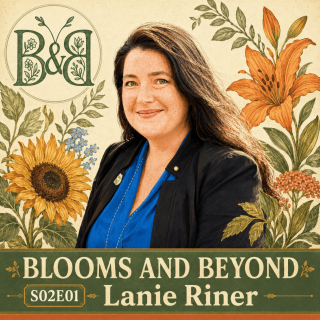
Ping Yu: welcome to the Blooms and Beyond podcast,
Ping Yu: a podcast that uncovers plant
Ping Yu: history,
Ping Yu: culture,
Ping Yu: and management through the lens of science.
Ping Yu: I'm your host,
Ping Yu: Ping.
Ping Yu: How's everyone doing
Ping Yu: today?
Ping Yu: I'm doing great because I have my dear, dear friend, Lanie Riner joining me today to talk about
Ping Yu: one of my favorite organizations.
Ping Yu: And I know she has so many good stories to share today.
Ping Yu: So I don't want to steal any more thunder from our speaker today.
Ping Yu: Let's just jump right into it.
Ping Yu: Without further ado,
Ping Yu: here is my conversation with Lanie. I hope you enjoy it.
Ping Yu: So hey, Lanie,
Ping Yu: welcome to the podcast.
Ping Yu: But first,
Ping Yu: let's start off with the introduction.
Ping Yu: Can you tell our audience a little bit about who you are and what you do?
Lanie Riner: I'm the Executive Director of the Georgia Green Industry Association and owner of Thunderwood Farms.
Lanie Riner: Thunderwood Farms, we are greenhouse growers,
Lanie Riner: so very much ornamental horticulture.
Lanie Riner: But my main job is GGIA,
Lanie Riner: and there we work.
Lanie Riner: work on advocacy and education and networking and communication for Georgia's green industry.
Lanie Riner: And my main area of focus,
Lanie Riner: of course, is advocacy.
Ping Yu: Yeah. So,
Ping Yu: well, I still remember the first time we met. It was during my interview for my current job.
Ping Yu: And I remember there was one moment it just clicked because we were talking about plants and you start to share information.
Ping Yu: the Ginkgo biloba tree that you had in your backyard.
Ping Yu: And this year, I still got a picture from you showing the beauty, the full color of that. So I still remember that.
Ping Yu: But do you,
Ping Yu: what first sparked your interest in horticulture in general? Do you grow up as a,
Ping Yu: plant kid, can you share us a little bit of your horticulture background and your horticulture journey?
Lanie Riner: Absolutely.
Lanie Riner: So yes,
Lanie Riner: I was a little farm kid.
Lanie Riner: And my grandmother,
Lanie Riner: my grandfather,
Lanie Riner: they didn't know the difference between their vegetable garden and their flower garden.
Lanie Riner: They planted all the things together everywhere.
Lanie Riner: The center of
Lanie Riner: And even at my house as a little kid with my parents,
Lanie Riner: there were flowers and vegetables and all the things.
Lanie Riner: But there were just no limits. Playing in the dirt,
Lanie Riner: planting things.
Lanie Riner: We wanted to mix things together that were fine.
Lanie Riner: Food and flowers,
Lanie Riner: they all went together and just...
Lanie Riner: So from a very early age,
Lanie Riner: I had the planting bug.
Lanie Riner: And then when I grew up and going off to college, I was like, well, I probably won't do this.
Lanie Riner: And I was in landscape architect program.
Lanie Riner: First, I was in pharmacy and I found out I was kind of scared of sick people.
Lanie Riner: But then I went to Landscape Architects at the north end of UGA campus.
Lanie Riner: And it didn't feel quite right.
Lanie Riner: And ended up back in horticulture down in Miller Plant Sciences and earned my degree there and knew this was the industry for me.
Lanie Riner: Um,
Lanie Riner: Well,
Ping Yu: that's very neat because,
Ping Yu: well, I laughed when you said you were...
Ping Yu: You don't like sick people from the pharmacy perspective.
Ping Yu: That's fair.
Ping Yu: Who does?
Ping Yu: But what is your favorite plant growing up?
Ping Yu: Well,
Lanie Riner: I've had a lot of favorite plants over the years from being little all the way to opening a greenhouse and even now.
Lanie Riner: But
Lanie Riner: This is a hard question,
Lanie Riner: but I will tell you,
Lanie Riner: there are two plants that impress me a lot.
Lanie Riner: Asclepias is always just so impressive to me. The flower structure is just so complex.
Lanie Riner: And when you start looking at all the different species and then just from the environmental standpoint,
Lanie Riner: the insects that rely on that as breeding ground and food source.
Lanie Riner: But the other one that I just love is,
Lanie Riner: is Baptisia.
Lanie Riner: And again,
Lanie Riner: it's another feeder plant,
Lanie Riner: but the flowers are just unique and the thing is so showy and it just grows up out of the ground so aggressively and so beautiful.
Lanie Riner: And I just have a really great appreciation for both of those plants.
Ping Yu: Yeah.
Ping Yu: And if you walk around any of those plants, you will say,
Ping Yu: well,
Ping Yu: especially when they bloom, you're going to say all those pollinators.
Ping Yu: It's just a different thing with other plants that may not have that much showy plants and are attracting that many pollinators.
Ping Yu: Yeah.
Ping Yu: Can you give us a little bit of the overview of GGIA?
Ping Yu: What is the mission and who do you serve?
Ping Yu: And if possible,
Ping Yu: can you tell us the history of GGIA?
Lanie Riner: GGIA is the state,
Lanie Riner: we're a 501c6 trade association.
Lanie Riner: And we represent ornamental and environmental horticulture here in the state.
Lanie Riner: The organization has been around since 1990.
Lanie Riner: It's GGIA.
Lanie Riner: It was formed from two other existing organizations.
Lanie Riner: Georgia Nursery Men's Association,
Lanie Riner: which dates back to the 1930s,
Lanie Riner: and then the Georgia Association of Landscape Professionals, which was coming on in the 70s and 80s.
Lanie Riner: The two industries realized how much they relied on each other.
Lanie Riner: And in 1990,
Lanie Riner: they pulled the trigger and merged the two organizations into GGIA.
Lanie Riner: So we serve the industry and that is wholesale growers,
Lanie Riner: Retail, greenhouse growers,
Lanie Riner: landscape contractors,
Lanie Riner: irrigation,
Lanie Riner: allied
Lanie Riner: products and sales,
Lanie Riner: and all of floriculture.
Lanie Riner: So we have six divisions.
Lanie Riner: That's not the order that they all came together,
Lanie Riner: but that's our industry.
Lanie Riner: And of course,
Lanie Riner: anything that comes with that.
Lanie Riner: So if you think about public gardens or golf courses or any of those industries that,
Lanie Riner: you know, they're not just adjacent, but they actually rely on and are part of the
Lanie Riner: our industry,
Lanie Riner: they are also part of our group.
Ping Yu: Yeah.
Ping Yu: Can you also tell us a little bit of backstory or background with how you started working with GGIA?
Ping Yu: Were you familiar with this organization or were you a part of that organization before you take on your current role?
Ping Yu: Yeah, absolutely.
Ping Yu: So,
Ping Yu: yeah.
Lanie Riner: My first time I learned about GGIA,
Lanie Riner: I was a college kid at UGA,
Lanie Riner: and Dr.
Lanie Riner: Smalley was like,
Lanie Riner: there's this trade show,
Lanie Riner: and y'all are going to go help load in, and if you don't show up,
Lanie Riner: You're gonna get a bad grade.
Ping Yu: That's something that's definitely something I would say.
Lanie Riner: Yes.
Lanie Riner: So my very first interactions,
Lanie Riner: I was,
Lanie Riner: we were unloading for our big trade show.
Lanie Riner: And back then it was in January,
Lanie Riner: it was winter green.
Lanie Riner: And it was just a wonderful experience.
Lanie Riner: It was,
Lanie Riner: it was,
Lanie Riner: it confirmed what I already knew, that there was a thriving industry and that there was a place for me there.
Lanie Riner: And then,
Lanie Riner: you know,
Lanie Riner: after graduating from college,
Lanie Riner: I went to work and,
Lanie Riner: you know, I didn't have as much interaction with GGIA. But when we opened our farm,
Lanie Riner: we ran into an issue before we ever got the doors open here in our county,
Lanie Riner: Meriwether County.
Lanie Riner: We had farmland.
Lanie Riner: Like I said, as I mentioned, I grew up.
Lanie Riner: We farmed all sorts of things. When I was a very little girl, we were peach farmers and then cattle.
Lanie Riner: And so when I wanted to put greenhouses,
Lanie Riner: I went to planting and zoning to get everything done.
Lanie Riner: And they were like, that's not agriculture.
Lanie Riner: You can't do that. That land's zoned agriculture.
Lanie Riner: Y'all just need to put that farm back into peaches.
Lanie Riner: And I was like, no,
Lanie Riner: it is agriculture.
Lanie Riner: And so, yeah,
Lanie Riner: I called the GGIA offices for help because I knew our industry was agriculture.
Lanie Riner: And honestly,
Lanie Riner: GGIA was able to help me right then before we were even members.
Lanie Riner: And we knew exactly what we needed to do to communicate with our county,
Lanie Riner: and help them understand that our sector,
Lanie Riner: the green industry,
Lanie Riner: is also agriculture as well.
Lanie Riner: And after that, I knew, I was like, okay, well, I have to be part of this to give back because we literally would have never been able to even get our greenhouse permits to get built had GGIA not been there to assist.
Lanie Riner: So.
Ping Yu: Oh, that's very neat connection over there because I was going to ask you a follow-up question.
Ping Yu: How did you do what?
Ping Yu: What opportunity actually brought you on board for GGIA for your current role?
Lanie Riner: Well,
Lanie Riner: that would be,
Lanie Riner: we can blame another UGA professor for this.
Lanie Riner: Dr. Paul Thomas drug me in and was like, we need some help on our education committee.
Lanie Riner: Laney, would you please come and help?
Lanie Riner: And so I came in as just a committee member.
Lanie Riner: We joined GGIA,
Lanie Riner: of course, after they helped me.
Lanie Riner: But I came in as a committee member, and then a committee member to a board member to division president,
Lanie Riner: and then I was working through executive leadership when our former executive director moved to a new position.
Lanie Riner: And just at that time, I was,
Lanie Riner: you know, I've been working on the advocacy side for GGIA and for our industry,
Lanie Riner: and I've been working on the advocacy side for GGIA.
Lanie Riner: for a lot of years.
Lanie Riner: And I was like, you know,
Lanie Riner: they may find somebody better,
Lanie Riner: but I really feel like I could help in that area.
Lanie Riner: So I applied for the job and I'm really glad that they hired me.
Ping Yu: Yeah,
Ping Yu: I think the industry is very happy to have you,
Ping Yu: considering how much you have accomplished over the years.
Ping Yu: I mean,
Ping Yu: I've been here only three and a half years,
Ping Yu: and I know how much you have contributed and achieved.
Ping Yu: But what are some of the key programs or services that GGIA currently provides to our stakeholders?
Ping Yu: Yes.
Lanie Riner: So the main thing that most of our members are members for is the advocacy piece.
Lanie Riner: And that's at state, local and federal levels.
Lanie Riner: And we have just recently,
Lanie Riner: and I think this will probably come out a little bit later.
Lanie Riner: It won't be new news by the time it comes.
Lanie Riner: by the time that the podcast is presented.
Lanie Riner: But we just recently partnered with the Georgia Agribusiness Council to do our lobbying at state.
Lanie Riner: And that is so I can be freed up to focus on some of the federal issues that we've been dealing with, like emerging pests and heat rule and other regulation that just...
Lanie Riner: can be overwhelming for all of us.
Lanie Riner: But aside from the advocacy,
Lanie Riner: we do our huge Southeast Green Conference,
Lanie Riner: which is a great opportunity for networking for all of our members.
Lanie Riner: It is in June.
Lanie Riner: And then we, of course, we have three days of education there.
Lanie Riner: We're really excited.
Lanie Riner: We're going back to Athens this year.
Lanie Riner: So there's going to be some great opportunities that we have not had in Duluth with tours and that kind of stuff. So I'm really excited about everything that's coming there.
Lanie Riner: We've done some other education,
Lanie Riner: Wintergreen on the Road, and we're currently working on reformatting that to see if we can get that where it's available to a broader audience.
Lanie Riner: And then there's an awards program,
Lanie Riner: scholarship programs for our next generation of horticulturists and horticulturists.
Lanie Riner: We are also,
Lanie Riner: we've got some other news.
Lanie Riner: I'm just not ready to share yet,
Lanie Riner: but we're,
Lanie Riner: we're working on it,
Lanie Riner: hoping that we can help fund some research and some of the other things that really help our industry thrive.
Ping Yu: Yeah.
Ping Yu: Cause I,
Ping Yu: I know that,
Ping Yu: um,
Ping Yu: um,
Ping Yu: the trade show,
Ping Yu: It kind of changed over the years and our Southeast Green used to be in the winter.
Ping Yu: So we are glad that it's been moved to June because more growers,
Ping Yu: um,
Ping Yu: more of our stakeholders are able to come. And also I'm very happy that we're moving to Athens because Duluth is not a perfect spot for
Ping Yu: a tree city like this.
Lanie Riner: Yes, it is. It is fabulous with all the trees and the plants and everything.
Lanie Riner: And,
Lanie Riner: you know,
Lanie Riner: Duluth is a wonderful city.
Lanie Riner: It's beautiful,
Lanie Riner: but it doesn't have that horticultural connection that Athens really has and has developed over a lot of years. And I think a big part of that is the university being there.
Lanie Riner: So we're really excited.
Lanie Riner: And it's.
Lanie Riner: It really kind of feels like a little bit of a homecoming.
Lanie Riner: So this show used to be in Athens a long time ago.
Lanie Riner: So we're really excited to be going back.
Lanie Riner: Yes.
Lanie Riner: We'll go where the exhibitors want to go.
Ping Yu: That's a great answer.
Ping Yu: I know that you have done a lot of good programs and initiatives and trying to spread the impact.
Ping Yu: to our industry.
Ping Yu: And can you highlight any specific programs or initiatives that have had some impact in the last few years,
Ping Yu: especially after you started?
Ping Yu: Because you started five years ago,
Ping Yu: right?
Ping Yu: It's a rough time.
Ping Yu: Yes.
Lanie Riner: Yes.
Lanie Riner: So I officially started in June of 2020.
Lanie Riner: But being the vice chairwoman of the organization on July 1st of 2020, I should have been starting as chairwoman of the organization rather than executive director.
Lanie Riner: But I was vice chair in February of 2020,
Lanie Riner: just before the shutdown.
Lanie Riner: And of course,
Lanie Riner: with our former executive director moving,
Lanie Riner: none of us knew anything that was coming was coming.
Lanie Riner: And so myself and our current chairman at that time,
Lanie Riner: Jeremy Oxford,
Lanie Riner: We were just very blessed that we were in a position to step up and advocate for the industry.
Lanie Riner: He and I both put in a lot of hours working to make sure that our industry was deemed essential,
Lanie Riner: that we could stay on the road, stay working. And it ended up being so many sectors of agriculture struggled through that first year.
Lanie Riner: Our industry did not.
Lanie Riner: In all the years that I've been in our industry,
Lanie Riner: I'd never had a spring where every weekend was pretty.
Lanie Riner: But that year that we were all shut down,
Lanie Riner: it's like it rained every Tuesday or Wednesday,
Lanie Riner: and we had beautiful weekends,
Lanie Riner: and the weather cooperated,
Lanie Riner: and no late frosts, and
Lanie Riner: So it was just,
Lanie Riner: it ended up actually being a really good year for our industry. And it was,
Lanie Riner: I think it was good because with so many people being shut down,
Lanie Riner: not being able to participate in their normal things,
Lanie Riner: being able to get out in their yard and reconnect with nature and,
Lanie Riner: maybe reconnect with their interest in our industry.
Lanie Riner: I know it's a good outlet for a lot of people.
Lanie Riner: So that was one big piece like right out of the gate.
Lanie Riner: But I think probably the one that one of the ones that I'm most proud of.
Lanie Riner: was the freedom to farm. And it wasn't our legislation.
Lanie Riner: It wasn't something solely for our industry.
Lanie Riner: It is something that impacts the entire agricultural industry all across the state.
Lanie Riner: Every single sector is impacted by that. And we've had that,
Lanie Riner: you know, we've had some rules on the books that,
Lanie Riner: since the 1980s,
Lanie Riner: but there was a changing conditions clause in there,
Lanie Riner: which put all of our farms at threat.
Lanie Riner: And I was able to write a letter to get in front of the legislators during session at critical times.
Lanie Riner: And we had some help with it from the Agribusiness Council and Georgia Farm Bureau in getting that letter to the right people at the right time. But just specifically outlining how this would impact our industry.
Lanie Riner: So many of our growers are located near urban areas.
Lanie Riner: They've been there for 30 or 40 or 50 or more years.
Lanie Riner: And town has grown to them.
Lanie Riner: And, um,
Lanie Riner: You know, a changing conditions clause. You can't just pick up a nursery and all the infrastructure and everything that is there and relocate just because town grew to you.
Lanie Riner: So getting that additional protection in there so that our folks who have been there for decades and decades could continue to farm and grow the plants and all the benefits that they bring.
Lanie Riner: That was just a really wonderful moment to get to have a part in that and be able to explain clearly to maybe to a lot of legislators that maybe did not understand.
Lanie Riner: You know,
Lanie Riner: so. Yeah,
Ping Yu: I think that's very important to our industry in general specifically because I have seen,
Ping Yu: I have visited many growers and have heard complaining from them.
Ping Yu: Because when they were there 40 years ago,
Ping Yu: 30 years ago,
Ping Yu: there's nothing there,
Ping Yu: just their farm. And they were doing that for years and years. And all of a sudden,
Ping Yu: because the population has skyrocketed,
Ping Yu: and they are looking for places to do their residential.
Lanie Riner: Well,
Lanie Riner: and I think a lot of it's just misunderstanding as well.
Lanie Riner: You know,
Lanie Riner: people who work in this industry realize the impact that their work has.
Lanie Riner: They know that the trees that they plant help with heat,
Lanie Riner: and they know that it keeps city streets cooler, and they know that it helps with water runoff, and they know all of the environmental benefits.
Lanie Riner: But I don't think that it's something that, you know, your average person
Lanie Riner: who's not working in that area,
Lanie Riner: they're not going to realize everything that that landscape and that plant is actually doing to make the city as a whole livable and wonderful for everyone.
Lanie Riner: So,
Lanie Riner: yeah, it's a tremendous impact and
Lanie Riner: You know, the role that our industry serves,
Lanie Riner: I always say,
Lanie Riner: you know, and I borrowed it from our predecessors.
Lanie Riner: So it's a little GGIA saying, we put nature back in place.
Lanie Riner: But it's exactly what we do after,
Lanie Riner: you know, our industry is where,
Lanie Riner: people and nature intersect.
Lanie Riner: you know,
Lanie Riner: And the work that we do makes that a fun experience for kids playing soccer or adults playing golf.
Lanie Riner: And it makes it a healthy experience.
Lanie Riner: Just having good landscape that protects and, you know,
Lanie Riner: offsets the heat or the cold or rain or all the other environmental factors that could come at you.
Lanie Riner: So yeah,
Lanie Riner: yeah, it's a it's a wonderful sector of agriculture to be part of.
Ping Yu: Yeah,
Ping Yu: I know there are many programs that we are doing that you guys are doing.
Ping Yu: But how do you measure the success of program because we normally would come back and take a reflection and say,
Ping Yu: oh,
Ping Yu: What did we do right?
Ping Yu: How can we improve so that we can constantly get better and better, right?
Lanie Riner: Yeah,
Lanie Riner: absolutely.
Lanie Riner: So we want our education,
Lanie Riner: you know,
Lanie Riner: GGIA,
Lanie Riner: we've done so many things with any organization being this old,
Lanie Riner: but one,
Lanie Riner: you know, the programming that we put forward from an educational standpoint,
Lanie Riner: we really do want it to be relevant to this moment and,
Lanie Riner: You know, we all have to have pesticide credits for our licensing.
Lanie Riner: you know, we want to be relevant to this moment.
Lanie Riner: Whether that's, and it's a different license for landscape than it is for the growers,
Lanie Riner: but it's all managed through the Department of Ag and the University of Georgia.
Lanie Riner: And so we want to provide great opportunities for that licensure,
Lanie Riner: for our arborist,
Lanie Riner: you know, because that's a big part of our industry as well.
Lanie Riner: I give opportunities for credits there where possible,
Lanie Riner: irrigation,
Lanie Riner: all of those things. We want to be professional.
Lanie Riner: And I mean, we were talking about this earlier,
Lanie Riner: but, you know,
Lanie Riner: emerging pests seem to be just a never-ending cycle.
Lanie Riner: So this past summer,
Lanie Riner: the two-spot cotton leaf hopper, and of course,
Lanie Riner: people are like, oh, well, that's cotton.
Lanie Riner: That's not us. But
Lanie Riner: Cotton is in the Malvaceae family.
Lanie Riner: There's an awful lot of hibiscus that gets moved around.
Lanie Riner: And we are part of that.
Lanie Riner: It has an impact on that.
Lanie Riner: And we've also found out that pest — it's on tomatoes and peppers and other solanaceous crops.
Lanie Riner: It was originally in Georgia found on okra,
Lanie Riner: which is another malvaceous crop. Not exactly.
Lanie Riner: It wasn't found on cotton. It was found on okra to begin with.
Lanie Riner: And, you know, ornamental,
Lanie Riner: we want to be good stewards to all of our industry in part.
Lanie Riner: And,
Lanie Riner: You know,
Lanie Riner: you know,
Lanie Riner: it's making sure that our growers have what they need to move plants safely from an education standpoint.
Lanie Riner: I know right now we're working through compliance agreements to make sure that our plants can keep moving responsibly, because we do want to be good stewards and make sure that we're not
Lanie Riner: Creating issues for others and spreading pests or any of those things.
Lanie Riner: But,
Lanie Riner: you know, our growers need that education.
Lanie Riner: So even if it didn't break even on or make a profit,
Lanie Riner: sometimes,
Lanie Riner: you know, it's timely and it's needed at that moment.
Lanie Riner: So,
Ping Yu: yeah,
Ping Yu: because sometimes you would just do if it's something right, you no matter what, you have to do it.
Ping Yu: Absolutely.
Ping Yu: Absolutely.
Ping Yu: So what type of support,
Ping Yu: if it's financial,
Ping Yu: educational,
Ping Yu: or technical,
Ping Yu: what kind of support are growers in Georgia most frequently seeking from GGIA?
Lanie Riner: A lot of it is the advocacy stuff.
Lanie Riner: The regulations over the last few,
Lanie Riner: and it's,
Lanie Riner: just exponential since I've entered the industry to now.
Lanie Riner: The amount of regulation that our growers are under and our landscape contractors are under,
Lanie Riner: like it's, it comes from every side.
Lanie Riner: So most recently,
Lanie Riner: I have been working on OSHA heat rule since 2021.
Lanie Riner: The
Lanie Riner: and it started in 2021 and
Lanie Riner: we just gotten through the post hearing comments so
Lanie Riner: we worked through we've been giving feedback the entire time
Lanie Riner: When they proposed the rule, we gave comments at that time.
Lanie Riner: Everything got put on hold with the change in administrations federally,
Lanie Riner: and then they picked it back up. I personally testified on behalf of the industry.
Lanie Riner: I wouldn't have been able to testify well without the help of the University of Georgia Extension and Dr.
Lanie Riner: Campbell.
Lanie Riner: working to get some of the real impact numbers from heat and to translate that into dollars.
Lanie Riner: Not just the temperatures,
Lanie Riner: but translating that into dollars in a scientific and sound way.
Lanie Riner: And then the post-hearing comments that were just due at the end of October.
Lanie Riner: So we're still working through that process.
Lanie Riner: A lot of these regulations,
Lanie Riner: they take a very long time.
Lanie Riner: I will tell you if that heat rule had were to go through the way it was originally proposed it would be catastrophic for our industry none of our people would be able to truly follow that regulation and that opens them up to fines and everything else from OSHA and it's just it's not a fair assessment you know.
Lanie Riner: If they can't follow the rule.
Ping Yu: Exactly. I know what you're talking about.
Ping Yu: But speaking of the advocacy,
Ping Yu: because last year I went to Washington,
Ping Yu: D.C., did my first time advocacy.
Ping Yu: And I was nerve-wracking because it's my first time.
Ping Yu: But since you have done so many times and with so many successful accomplishments,
Ping Yu: what do you think will make it a good advocacy,
Ping Yu: Yeah.
Ping Yu: elevator pitch?
Ping Yu: Like, how do you prepare to do that? Because a lot of times,
Ping Yu: even for me, first time doing it, I was like, oh, what should I say? What message do I need to deliver?
Ping Yu: And things like that.
Ping Yu: Do you have any thoughts or opinion or suggestion on that?
Lanie Riner: I do.
Lanie Riner: I know the answer.
Lanie Riner: In our society,
Lanie Riner: throughout every society,
Lanie Riner: we learn through storytelling.
Lanie Riner: And it doesn't matter.
Lanie Riner: It doesn't see any nationality. It doesn't matter what it is. We all learn through storytelling.
Lanie Riner: So when you go to talk to a legislator or a regulator,
Lanie Riner: you're,
Lanie Riner: Whatever the point is that you are trying to make,
Lanie Riner: it needs to be a true story.
Lanie Riner: That's the first thing.
Lanie Riner: And it needs to, it's even better if it's your story.
Lanie Riner: So being able to connect that real impact to you personally and how it impacts you as their constituent or you as a part of this industry.
Lanie Riner: That message is going to come through a thousand times louder than, you know, here are some facts and figures.
Lanie Riner: Now,
Lanie Riner: they need those facts and figures,
Lanie Riner: and there needs to be a piece of paper that you leave behind with them,
Lanie Riner: but that story is what they're going to remember.
Lanie Riner: When that comes up for that vote, they're going to remember.
Lanie Riner: That story and you telling them that real impact.
Lanie Riner: That's what's going to be on play in their head,
Lanie Riner: not that piece of paper with those numbers.
Lanie Riner: So anytime you're going to talk to someone,
Lanie Riner: really thinking through, one,
Lanie Riner: what message you're trying to get across,
Lanie Riner: and two, how that connects to you in real life, and three,
Lanie Riner: what story you can help them remember that by,
Lanie Riner: that is the way to do it. And
Lanie Riner: It gets easier.
Lanie Riner: Like,
Lanie Riner: once you've got some practice and you have a few successes, it gets easier.
Lanie Riner: But that is,
Lanie Riner: it is nerve-wracking.
Lanie Riner: You're right.
Lanie Riner: And I'm so proud that you went and did it anyway,
Lanie Riner: because we need people to show up and tell their stories.
Ping Yu: Yeah, speaking of that...
Ping Yu: What do you do as organization and chair of the organization to maintain the relationship or establish the relationship between our industry and legislator?
Lanie Riner: So glad you asked me this.
Lanie Riner: I know. We lean into who we are.
Lanie Riner: So I inherited a great program. It is the GGIA Capital Day. And we go in February and we don't have talking points unless we do have talking points. But we don't go for that. We go to give away plants and help people know who they're.
Ping Yu: Yeah.
Lanie Riner: We are.
Lanie Riner: And it is a wonderful time at the Capitol.
Lanie Riner: It is during session. And a lot of the agricultural commodities do this.
Lanie Riner: There's peanut butter and jelly day from the Peanut Commission.
Lanie Riner: The Cattlemen have state biscuit day.
Lanie Riner: And GGIA has their Capitol day where we give away plants.
Lanie Riner: And one of the favorite things that I've been told about this,
Lanie Riner: Chairman Robert Dickey called me and I'd asked for his help in making sure that we were all organized a few years back. And he said,
Lanie Riner: he said, Laney, don't y'all ever stop doing this.
Lanie Riner: It's important.
Lanie Riner: And,
Lanie Riner: you know, for those of you that know,
Lanie Riner: Chairman Dickey is a peach farmer.
Lanie Riner: And he said, all of us come up there and we represent our different commodities.
Lanie Riner: But yours is the only industry that it is not eaten up at the end of the day.
Lanie Riner: Literally.
Lanie Riner: So,
Lanie Riner: and I was thinking about, I'm like,
Lanie Riner: he's right.
Lanie Riner: Every other sector of ag, they bring food, which is wonderful because people need to eat.
Lanie Riner: But ours is still sitting there at the end of the day and next week.
Lanie Riner: And if you ever get to go on a capital day,
Lanie Riner: sometimes you'll go into offices and there's plants.
Lanie Riner: a lot of plants from years past where these plants are still there and they're excited to see us.
Lanie Riner: And building off of that, we have begun to do a holiday plant drop,
Ping Yu: Yeah.
Lanie Riner: which is really for the legislative assistance when everything is a little bit more quiet around.
Lanie Riner: And we are also doing some tours,
Lanie Riner: some legislative tours at the county level.
Lanie Riner: And that way we can help some of our county folks.
Lanie Riner: And we invite the state and the federal folks to those tours.
Lanie Riner: You know,
Lanie Riner: tours as well.
Lanie Riner: It's really a great opportunity for us to show firsthand what our industry does.
Ping Yu: Do you foster communication among growers across the state? Because I have been to some of the nursery visits with you. But besides that,
Ping Yu: how do you communicate with our stakeholders?
Lanie Riner: So,
Lanie Riner: well,
Lanie Riner: the trade show is one big way that we communicate,
Lanie Riner: but of course,
Lanie Riner: you know,
Lanie Riner: there are things. I mean,
Lanie Riner: last night,
Lanie Riner: Yes.
Lanie Riner: I was getting ready to go to the basketball,
Lanie Riner: my child's basketball game,
Lanie Riner: when the message about a new emerging pest came in,
Lanie Riner: and so...
Lanie Riner: We use social media,
Lanie Riner: but really for direct contact with our growers,
Lanie Riner: email is the quickest and most efficient way.
Lanie Riner: So we have an e-blast system that we use.
Lanie Riner: And if I know they need it, as soon as it comes through, I forward them to them because they will answer the email from me, even if they don't read that e-blast, especially when we're talking about emerging pests or some of the other things that are just...
Lanie Riner: high impact in that moment.
Lanie Riner: The two-spot cotton leaf hopper in particular with quarantines beginning to pop up,
Lanie Riner: that could create some real issues for our folks.
Lanie Riner: And,
Lanie Riner: you know,
Lanie Riner: I'm so grateful for our partnership.
Lanie Riner: with the University of Georgia and helping us know what we need to do to treat for those pests. But I'm also grateful for our partnership with the Georgia Department of Agriculture in helping us make sure that we're following the guidelines and doing what we need to do to keep our plants moving,
Lanie Riner: especially when you start talking about a quarantine pest or something like that.
Lanie Riner: So,
Lanie Riner: Anything that we can do to get that message out quickly and efficiently,
Lanie Riner: that's,
Lanie Riner: you know, when it needs to go, it's going to go.
Lanie Riner: So,
Lanie Riner: but the email,
Lanie Riner: the e-blast is really probably the quickest and easiest.
Lanie Riner: most efficient way for us to get information to a large number of people.
Ping Yu: Yeah, and I want to mention that during emergency circumstances such as Hurricane Helene or other type of events like that,
Ping Yu: you guys did a great job by calling them if they still have the information.
Ping Yu: the power,
Ping Yu: if not email.
Ping Yu: But we'll find a way to check on you to make sure you are good and make sure if you need anything,
Ping Yu: we'll try to help you out. And that's what I got from you guys because I think that's very important,
Ping Yu: especially during those devastating times.
Lanie Riner: But I was so, I'm always so humbled by
Lanie Riner: how generous our industry members are with each other.
Lanie Riner: And I myself,
Lanie Riner: our farm suffered a devastating tornado that took down everything in 2020.
Lanie Riner: And I cannot tell you how many people came to help us get back on our,
Lanie Riner: not 2020,
Lanie Riner: 2017.
Lanie Riner: And I can't tell you how many of our folks came to help us get back on our feet and stuck with us until we were.
Lanie Riner: And it was the same thing during Hurricane Helene. Our GGIA chairman at that time went and got a generator from someone else and took it to another farm.
Lanie Riner: Their power was restored and he went and got it, drove through all of that.
Lanie Riner: to get it to them.
Lanie Riner: And our rising treasurer was calling everywhere,
Lanie Riner: sourcing generators to try to get to our folks.
Lanie Riner: And it was just,
Lanie Riner: I'm just always so humbled.
Lanie Riner: Another one of our growers who had generators,
Lanie Riner: They had them shipped on. They had them strapped tractor trailers and ready to go to other farms that needed them. And I'm just always so humbled by how this industry sticks up for each other and takes care of each other.
Lanie Riner: And, you know,
Lanie Riner: GGIA,
Lanie Riner: we serve as a connector.
Lanie Riner: in that capacity,
Lanie Riner: but it is not us that is doing it. It is our members helping each other.
Lanie Riner: And that's one of the things that is so special about this industry and this trade association is this,
Lanie Riner: they really do work together to take care of everyone.
Lanie Riner: So,
Lanie Riner: yeah, it's a wonderful thing to be a part of.
Ping Yu: It is. And it is a people,
Ping Yu: right?
Ping Yu: We work together and make this thriving industry.
Ping Yu: But what are the biggest challenges that our growers facing today and how GGIA is addressing them?
Lanie Riner: Well,
Lanie Riner: succession planning is one.
Lanie Riner: That's a hard one.
Lanie Riner: And I think we're seeing that in a lot of sectors of agriculture.
Lanie Riner: It is harder and harder.
Lanie Riner: for people who are wanting to enter the industry,
Lanie Riner: especially on the production side,
Lanie Riner: to get a foothold.
Lanie Riner: And it's cost prohibitive in a lot of ways.
Lanie Riner: And,
Lanie Riner: you know,
Lanie Riner: the succession planning part is...
Lanie Riner: You know, you've got growers who maybe their children did not pick up the industry.
Lanie Riner: And so how to transition that farm to move forward into the next generation if it's not a pass,
Lanie Riner: a transfer from family member to family member.
Lanie Riner: So that is one challenge.
Lanie Riner: And I think we're all still struggling with that, but it's something that we're certainly struggling.
Lanie Riner: trying to figure out.
Lanie Riner: We've seen some very creative solutions that have come through for some of our growers,
Lanie Riner: and I'm so proud for them.
Lanie Riner: And then we've had others who have ended up selling,
Lanie Riner: and that's a little bit sadder outcome,
Lanie Riner: but it ended up for their family. I mean, they're okay,
Lanie Riner: you know, but I'm
Lanie Riner: But it's just,
Lanie Riner: it's hard for me as the executive director to see acreage go out of production. It just, it makes me sad.
Ping Yu: I totally get it.
Ping Yu: Because you,
Ping Yu: and a lot of those family-owned nurseries,
Ping Yu: it's for generations.
Ping Yu: And some of them, if it's for more than two generations,
Ping Yu: they got a legacy to it already.
Ping Yu: And then it's hard to say them disappear.
Ping Yu: For good,
Ping Yu: you know.
Ping Yu: So I totally get it.
Lanie Riner: Go ahead.
Lanie Riner: Other than that,
Lanie Riner: I think regulation and labor.
Lanie Riner: I'll go ahead and say the big ones.
Lanie Riner: Regulation,
Lanie Riner: labor,
Lanie Riner: and water.
Lanie Riner: Those are always going to be three huge challenges.
Lanie Riner: Labor is a federal issue in a lot of ways.
Lanie Riner: We rely on the H-2A and H-2B programs,
Ping Yu: That's a big one.
Lanie Riner: which are federal programs.
Lanie Riner: And GGIA spends a lot of time working on H-2A and H-2B labor.
Lanie Riner: The other regulatory issues that really we struggle with have been federal and just,
Lanie Riner: you know,
Lanie Riner: waters of the U.S.
Lanie Riner: WOTUS.
Lanie Riner: It has been back and forth since 2008,
Lanie Riner: and the Supreme Court has ruled in between,
Lanie Riner: and they have ruled again,
Lanie Riner: and the definition keeps changing, and it's been picked up again.
Lanie Riner: Just most recently,
Lanie Riner: like less than two weeks ago,
Lanie Riner: by the Trump administration.
Lanie Riner: And so water remains one of those things.
Lanie Riner: Like,
Lanie Riner: it's just a hard thing.
Lanie Riner: Because especially interstate waters,
Lanie Riner: it's not a state issue.
Lanie Riner: It is a federal issue.
Lanie Riner: But water can also be a state issue.
Lanie Riner: In times of drought, our growers are,
Lanie Riner: are protected and are able to grow.
Lanie Riner: But if water is cut off in Atlanta, as it was in 2007,
Lanie Riner: you'll have a lot of growers go out of business because people can't water.
Lanie Riner: And so just good stewardship and making sure that, you know,
Lanie Riner: our industry's voice is represented properly.
Lanie Riner: Plants are incredibly resilient.
Lanie Riner: And once they're established,
Lanie Riner: they don't need the level of water that sometimes people give them. We live in Georgia,
Lanie Riner: and it's right at 50 inches of rain a year,
Lanie Riner: and that's an incredible amount. But then when it gets dry, it gets really dry.
Lanie Riner: So labor,
Lanie Riner: water,
Lanie Riner: those things are always...
Lanie Riner: is going to cause us challenges.
Lanie Riner: And it's something that we're constantly working on.
Ping Yu: Yeah,
Ping Yu: yeah.
Ping Yu: How do you collaborate with universities,
Ping Yu: extension agents or industry partners?
Ping Yu: We briefly touched base on some of those,
Ping Yu: but can you elaborate a little bit?
Ping Yu: Sending texts at 5:30 in the afternoon.
Lanie Riner: That's what happened yesterday.
Lanie Riner: No,
Lanie Riner: we could not advocate for our industry at all without our university partners and extension.
Lanie Riner: Yeah.
Lanie Riner: Extension provides that unbiased scientific support.
Lanie Riner: It's not an opinion.
Lanie Riner: It is unbiased scientific reasoning and support for our position.
Lanie Riner: And if the science does not back it up, well, we're on our own with our position.
Lanie Riner: But the partnership really is critical.
Lanie Riner: I don't see anyone in our industry.
Lanie Riner: We all lean into the science that exists to make sure that our plants are grown healthy and quickly and efficiently,
Lanie Riner: that we can ship them from place to place.
Lanie Riner: We could not do it without,
Lanie Riner: like, you as our state specialist for nursery and greenhouse,
Lanie Riner: Dr.
Lanie Riner: Joseph with our state entomologist,
Lanie Riner: Dr.
Lanie Riner: Campbell,
Lanie Riner: our state economist,
Lanie Riner: The other Dr.
Lanie Riner: our state's
Lanie Riner: Campbell,
Lanie Riner: with her extension appointment in consumer horticulture and market trends,
Lanie Riner: our new pathologist,
Lanie Riner: his name has escaped me.
Lanie Riner: Because...
Lanie Riner: Yes.
Lanie Riner: Yes.
Lanie Riner: He,
Lanie Riner: it was Dr.
Lanie Riner: Williams-Woodward for many, many years.
Lanie Riner: Yeah.
Ping Yu: Yeah.
Lanie Riner: But he is new in that role,
Lanie Riner: but we could not do it without those partnerships and to help us problem solve.
Lanie Riner: A lot of times,
Lanie Riner: we're.
Lanie Riner: We don't know what we're dealing with, or we don't know.
Lanie Riner: We may be able to treat something,
Lanie Riner: but maybe it's not really scalable,
Lanie Riner: or maybe something that we're doing is causing the problem.
Lanie Riner: And just without those partnerships from the university,
Lanie Riner: our industry would not be where it is.
Ping Yu: Here is the fun part,
Ping Yu: because I know you have big vision.
Ping Yu: That's why I say you're an inspiring women leader in horticulture.
Ping Yu: You got big vision for GGIA.
Ping Yu: Can you tell us what is your vision for GGIA in the next three to five years?
Ping Yu: Oh, I do know.
Lanie Riner: Can I tell you? I don't know.
Lanie Riner: I would say for our industry,
Lanie Riner: I don't know.
Lanie Riner: I would love to see our industry better united.
Lanie Riner: It's something we've always leaned into partnerships and we value that,
Lanie Riner: but really bringing that full circle and just a really united industry with one voice that represents from an advocacy standpoint that is a tremendous strength.
Lanie Riner: From a size and scale,
Lanie Riner: I don't think that people really realize the size of the industry,
Lanie Riner: the scope, the economic impact.
Lanie Riner: And,
Lanie Riner: you know,
Lanie Riner: when things come up,
Lanie Riner: they don't always realize the impact to different sectors of the industry as well. So that united voice is really...
Lanie Riner: something that we will continue to work towards.
Lanie Riner: Other things that I would love to see for our industry and for our trade association is to be able to make some headway on some of these really big issues.
Lanie Riner: And that is going to take work.
Lanie Riner: It's going to take advocacy.
Lanie Riner: It's going to take member
Lanie Riner: engagement.
Lanie Riner: And it's going to take working together and partnering in a lot of different
Lanie Riner: arenas to get everyone rowing together in the same direction.
Lanie Riner: But it is not something that I'm scared of.
Lanie Riner: It is something that
Lanie Riner: I lean into partnerships.
Lanie Riner: You know, we are stronger together.
Lanie Riner: It feels like a cliché after so much that we've gone through, but it was true before COVID. It was true during COVID, and it's true now.
Lanie Riner: We are stronger when we work together.
Lanie Riner: But, um,
Lanie Riner: Fort Valley,
Lanie Riner: Georgia.
Lanie Riner: And it is a program that we have had since 1991.
Lanie Riner: And it's the GGIA Junior Certified Plant Professional.
Lanie Riner: The Georgia Certified Plant Professional was GGIA's program until we transitioned it to UGA so it could be state recognized.
Lanie Riner: So that program is managed by
Lanie Riner: UGA now. So it does have that state recognition.
Lanie Riner: But we still maintain the junior certification and we installed a plant ID trail for students from all over the state to be able to come, learn their plants,
Lanie Riner: take the test,
Lanie Riner: and
Lanie Riner: Gain Interest and Skills that are relevant in our industry.
Lanie Riner: And those are the type of things that I hope to see for our industry.
Lanie Riner: Young people, and we know we have to get them in middle school or high school.
Lanie Riner: Like, if it's college,
Lanie Riner: a lot of times it's too late. They're on a path that they can't transition over to if they find it late.
Lanie Riner: So being able to cultivate that interest early and gain interest.
Lanie Riner: them being able to see that there is a viable pathway.
Lanie Riner: There is an extremely wonderful young lady that I have met through FFA, and she is a senior in high school this year.
Lanie Riner: And I met her as a freshman,
Lanie Riner: and she was competing in the state floriculture competition.
Lanie Riner: And I got the opportunity to ask her what she wanted to be,
Lanie Riner: you know, was she going to enter this industry?
Lanie Riner: after she graduated and she said, I'm going to be an agricultural attorney.
Lanie Riner: She said, but I hope that I'm able to help horticulture and all of these other sectors of agriculture that I've learned about through that work.
Lanie Riner: Yeah.
Lanie Riner: And so even though she will not be...
Lanie Riner: working directly in this industry, I have no doubt that her work is going to impact us.
Lanie Riner: And as a senior,
Lanie Riner: I have no doubt that she is going to get to where she is going because I saw her a couple of weeks ago at our ribbon cutting and she is still planning to be an agricultural attorney.
Ping Yu: That's great.
Ping Yu: We want those kids.
Ping Yu: Yeah.
Lanie Riner: We do.
Lanie Riner: The vision for our industry is help growing the next generation of horticulturists and help growing our industry where we are right now in all stages.
Lanie Riner: So I know that was a long answer to that because it's a big industry and that's a big answer.
Ping Yu: It's a good answer.
Ping Yu: We always would want.
Ping Yu: to have the next generation to get involved.
Ping Yu: Yes.
Ping Yu: Because we're cultivating our future by engaging them.
Ping Yu: That's right.
Ping Yu: Yeah.
Ping Yu: So if any of the volunteers or growers or even students or extension agents
Ping Yu: wants to be get involved in GGIA.
Ping Yu: Where should they get started?
Lanie Riner: We'll find a spot wherever they want to be.
Lanie Riner: This is what I love about this organization.
Lanie Riner: You can, if you're not into the advocacy piece,
Lanie Riner: that's okay.
Lanie Riner: We need help with education.
Lanie Riner: We need help with these little events that we are doing. We need help with all of these things.
Lanie Riner: If you are interested in helping with student development,
Lanie Riner: we'll connect you with our partners with FFA,
Lanie Riner: and there's opportunities to judge students. I know our
Lanie Riner: Our central region and north region and south region FFA region teachers,
Lanie Riner: they are horticulture teachers who teach all of the ag teachers in their region and run those contests.
Lanie Riner: They are always looking for help.
Lanie Riner: I got a great opportunity in October to go and judge at nationals in Indiana.
Lanie Riner: And I'm just going to tell you, it blew me away to see.
Lanie Riner: So,
Lanie Riner: If someone wanted to get involved in that area,
Lanie Riner: there's an opportunity.
Lanie Riner: If they're really interested in trade show or education or advocacy or helping with these events,
Lanie Riner: there is something for everyone.
Lanie Riner: And just reach out. We'll be so glad to help connect and get you plugged in where you're.
Lanie Riner: you feel comfortable in another area in a few years and we'll move you over there.
Ping Yu: Yeah.
Ping Yu: Yeah.
Ping Yu: And now GGIA has a website and you can find more information there.
Ping Yu: And I'll definitely put the link in the show notes so people can go and check after they pull it up,
Ping Yu: you know.
Lanie Riner: Yes.
Lanie Riner: Oh,
Lanie Riner: and one last plug for Southeast Green.
Lanie Riner: Can we put both of the websites? Of course.
Lanie Riner: Of course.
Ping Yu: I can do that. I can do that. Thank you.
Ping Yu: Of course.
Ping Yu: Well,
Ping Yu: I thank you, Lanie, for taking time out of your busy schedule to talk with me.
Ping Yu: And like I said, I think we will make good, we'll do good things and make the whole industry better all together.
Ping Yu: So thank you.
Ping Yu: Thank you.
Ping Yu: And as always,
Ping Yu: go check out the show notes to learn more about this topic and other topics we featured on the show at bandbpod.com.
Ping Yu: Thank you for listening.
Ping Yu: Till the next time,
Ping Yu: stay healthy and go plants!