0:00Welcome to Blooms and Beyond
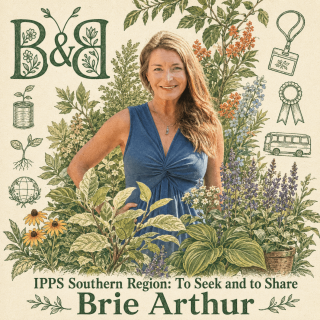
In 1951, nurseries still grew plants in tin cans, and information on rooting hormones was hard to come by. The society that formed to close that gap, the International Plant Propagators Society, is now the International Plant Production Society, and its Southern Region leads every IPPS region in the world for membership. Dr. Ping Yu sits down with Brie Arthur, “Brie the Plant Lady,” International Delegate and Communications Director for IPPS Southern Region, to explain how a 75-year-old organization keeps drawing in the next generation.
Brie has been part of IPPS for more than a decade, and she traces nearly every mentor in her career back to it: Fred Davies, David Creech, Tom Saunders, Tom Yeager. She walks through the region’s scholarships, including the Coach Vince Dooley Student Scholarship and the Margie Jenkins First-Time Conference Attendee Scholarship, and tells the story of the 2014 Early Career Exchange that sent her to Denmark. Ping adds her own memory of meeting Tom Yeager at the 2019 student competition and feeling, in her words, like she had met a celebrity.
The conversation keeps returning to one idea: plants bring people together, but the people are the reason anyone gathers. Ping and Brie make the case for showing up in person, for the talk on the bus and the conversation at dinner that no webinar reproduces. Whether you grow plants for a living, teach horticulture, or picked it up in retirement, there is a seat for you. The next meeting is in Houston, October 2026.
Listen Time: 48:07 Follow Along with the Transcript
Brie Arthur (“Brie the Plant Lady”), International Delegate and Communications Director, IPPS Southern Region. A Purdue-trained horticulturist who was introduced to IPPS as an undergraduate, Brie now focuses on consumer horticulture and food gardening, translating technical nursery research for master gardeners and home growers.
Host: Dr. Ping Yu, UGA Department of Horticulture, and a member of the IPPS Southern Region board.
Brie Arthur: “The mission of IPPS is to seek and share plant knowledge globally, and it is a global network of plant production professionals.”
Brie Arthur: “Plants are what unite us, but it’s the time we spend together that is what truly matters.”
Brie Arthur: “I was the recipient of the exchange program in 2014, and I went to Denmark, and it completely changed my life.”
Dr. Ping Yu: “This organization has lifted me up, and now it’s time for me to pay it forward.”
Brie Arthur: “The future is green.”
From Propagators to Production. IPPS kept its acronym but changed its name from the International Plant Propagators Society to the International Plant Production Society. The reason is structural: a modern nursery might specialize only in young plants, or only in growing those plants on to finish. “Production” covers the whole cycle rather than one step of it.
Why 1951 mattered. When IPPS started, auxins and other natural plant hormones were just being discovered, and there was no easy way to share rooting techniques without a society and its published proceedings. The original purpose was to let academics get propagation information to a young, growing nursery profession.
Propagation, plainly. A nursery produces plants from seed, cutting, or graft. Improved, well-bred genetics are often patented, which is part of why young-plant nurseries exist: they can manage the royalties before the plant moves down the production line.
Substrates and particle size. Brie points listeners to the soilless substrate research of Dr. Jeb Fields (formerly LSU, now University of Florida) and Dr. Brian Jackson. Particle size governs how long a mix holds water and fertilizer. Stratified substrates layer different particle sizes for better performance, but they need multiple potting machines, so commercial adoption is slow. Home container gardeners can use the same idea without the machinery.
Hot pots and sun scald. Dr. Jeremy Pickens gave a talk this year on how dark containers heat the root zone as summers get hotter. White containers keep roots cooler, which is why Brie tells home growers to use ornamental white pots for container tomatoes to reduce sun scald.
Southern native trees and shrubs. Margie Jenkins built one of Louisiana’s most important nurseries specializing in southern natives, a category Brie says still needs more development.
Blooms and Beyond explores plant history, culture, and management through the lens of science. Whether you’re a commercial grower seeking practical solutions, a student exploring careers in horticulture, or simply someone who loves plants and their stories, there’s something here for you. Hosted by Dr. Ping Yu of the University of Georgia, each episode features interviews with experts who share enchanting stories, cutting-edge research, and practical wisdom from the world of horticulture.
Your benefit: After each episode, commercial growers will have at least one useful tip for their operation, and plant enthusiasts will have an interesting fact to share. That’s how we spread plant power to more people and make our environment a little better.
Host: Dr. Ping Yu Producer: Rich Braman Guest: Brie Arthur, International Delegate and Communications Director, IPPS Southern Region
Episode Release Date: July 19, 2026 Episode Length: 48:07
“Till next time, stay healthy and go plants!” 🌱