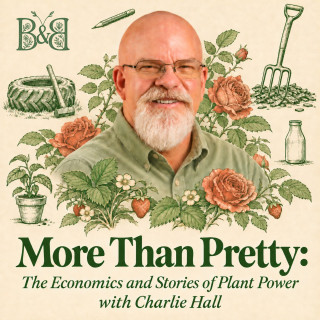
S03:E01
Charlie Hall’s family ran a sideline nursery in western North Carolina. They potted up plants in the backyard, hauled free pine bark from the paper mill where his father worked, and priced everything a little below the average of the catalogs they picked up at the trade show. That nursery is no longer in business, and Charlie, now Professor and Ellison Endowed Chair in International Floriculture at Texas A&M University, calls that his number one lesson for growers: price your plants too cheap and you go out of business. The numbers he works with have grown since then. The first economic impact analysis of the green industry, in 2005, found $164 billion. The survey his team just finished puts it around $550 billion.
But Charlie tells Ping the numbers are not the answer, even coming from an economist. Stories are. He tells two of his own. A workout boot camp in a College Station park put a weight on his chest that led to a quadruple bypass, and his father, who died with dementia, was “more like the old dad again” when he was outside potting up a plant. From there the conversation moves through stormwater and green infrastructure, school gardens and ADHD, community gardens in Philadelphia, prison horticulture programs, and how the International Junior Master Gardener program started at a federal women’s prison in Bryan, Texas.
The second half turns to the business side. Sales jumped during the pandemic and have plateaued instead of falling back to 2019. Growers ask him privately about working capital and financial ratios. A Got Milk style campaign for plants, he argues, would only work while it ran. His goal for the next twenty years is a world where people prefer plants versus pills. He closes with the skill he credits for his whole career, two ears and one mouth, and with news that surprised Ping: at the January 2026 recording, he planned to retire from Texas A&M in eighteen months.
Listen Time: 57:47 Follow Along with the Transcript
Dr. Charlie Hall, Professor and Ellison Endowed Chair in International Floriculture, Texas A&M University. The chair deals with the flower side of the business, but as an economist he covers the entire green industry, because “it still comes down to jobs and it comes down to economic impact.” He grew up in western North Carolina, where his father was a millwright at the Champion Paper Mill and the family ran a sideline nursery. He earned an undergraduate degree in agricultural economics with a horticulture minor and a master’s in horticulture at the University of Tennessee, then a PhD at Mississippi State, where he built a linear programming model to optimize nursery profitability under labor and resource constraints. He joined Texas A&M in 1988 and the S-103 multistate research committee. He runs EAGL, the Executive Academy for Growth and Leadership, and its spin-off, Your Market Metrics.
Host: Dr. Ping Yu, UGA Department of Horticulture
“we gotta have a value proposition of more than pretty.” Dr. Charlie Hall, on what the industry has to sell (45:52)
“I attribute green spaces to actually saving my life.” Dr. Charlie Hall, on the park boot camp that led to his quadruple bypass (22:51)
“I could tell you those things, but for me to tell my story about my own father is more powerful.” Dr. Charlie Hall, on healing gardens and his father’s dementia (25:48)
“It has so much more layers to it.” Dr. Ping Yu, on what she hopes listeners see the next time they look at a plant (28:40)
“the greatest single skill that I’ve relied on my entire career is the fact that I have two ears and one mouth. And it may be hard to believe, but I try to use them in that proportion.” Dr. Charlie Hall (51:50)
Pricing between a floor and a ceiling. Charlie describes the strategy his family’s nursery did not use: take what a plant costs to produce as the floor for its price, and the customer’s willingness to pay as the ceiling (5:55).
Economic contributions, not sales. The green industry’s economic contributions count growers, service providers such as landscape contractors, and retail. Retail now includes box stores and several kinds of mass merchandisers along with garden centers.
Three kinds of value. Charlie sorts the industry’s case into economic contributions, ecosystem services benefits, and health and well-being benefits (18:21). Aesthetics, he says, is “a value proposition that only takes us so far as an industry” (18:41). On the economic side he talks most about property values, which rise when there are green spaces around or in them through biophilic design: green roofs, green walls and natural lighting.
Green versus gray infrastructure. Gray infrastructure is the piping and sewer systems built to carry stormwater away. Green infrastructure handles the same water with plants: the tree canopy holds part of it and releases it slowly, and more of it percolates through the soil instead of running off. Resource economists now work on putting a dollar value on what that does, from mitigating stormwater runoff and erosion to filtering water before it reaches aquifers and removing particulates from the air.
Healing gardens. Gardens at hospitals and at Alzheimer’s and dementia clinics benefit both patients and staff, Charlie says, with less staff turnover. He cites memory retention in dementia and Alzheimer’s patients enhanced by as much as 20 percent in green spaces (24:21).
Horticultural therapy. Ping names the research field behind these stories. Texas A&M’s newest certification in its Department of Horticultural Sciences will be horticultural therapy, and Ping notes that UGA also has one (29:06).
The stay-at-home effect and elasticity of demand. When people spend more time at home, they spend more on home improvement, and landscaping is one of those expenditures. With the papers and the media covering the benefits during the pandemic, Charlie thinks the industry did a better job of talking about them and influenced the elasticity of demand (35:08). Sales are at what he calls a new normal.
Stated versus revealed preference. A stated preference is what people say in a survey. A revealed preference is measured through independent means: whether they actually buy. Researchers measure it with eye tracking, biometrics and experimental auctions, and Charlie says some of the first experimental auctions were done in horticulture. He calls Bridget Behe of Michigan State a true pioneer of this consumer behavior research, and names Chengyan Yue of Minnesota as another researcher who has done a lot of work in the area.
Recidivism. The likelihood that someone goes back to prison after release. Prisons with horticultural programs, whether growing food for the prison or running job training, have lower recidivism rates (37:22). Charlie knows graduates of a horticultural program at the Federal Men’s Prison who now own businesses in Houston.
Three things for growers. On stage at Cultivate, Charlie tells growers to manage their working capital, push the pencil a little harder, and develop a value proposition that resonates with their customer base (43:02). Growers then ask him what those mean in practice, and EAGL and Your Market Metrics give them real numbers: financial and operational ratios they can compare against other businesses.
Siloed data. Enterprise resource planning (ERP) systems are the big software packages growers use, but Charlie says they share too little data to support decisions across a business or across the industry (47:09). He sees uses for AI in sales and production plans, space allocation and sales messaging, and notes that HRI is trying to put more grant dollars toward AI.
Blooms and Beyond explores plant history, culture, and management through the lens of science. Whether you’re a commercial grower seeking practical solutions, a student exploring careers in horticulture, or simply someone who loves plants and their stories, there’s something here for you. Hosted by Dr. Ping Yu of the University of Georgia, each episode features interviews with experts who share enchanting stories, cutting-edge research, and practical wisdom from the world of horticulture.
Your benefit: After each episode, commercial growers will have at least one useful tip for their operation, and plant enthusiasts will have an interesting fact to share. That’s how we spread plant power to more people and make our environment a little better.
Host: Dr. Ping Yu Producer: Rich Braman Guest: Dr. Charlie Hall, Professor and Ellison Endowed Chair in International Floriculture, Texas A&M University
Episode Release Date: November 8, 2026 Episode Length: 57:47
“Till next time, stay healthy and go plants!” 🌱