Blooms and Beyond
Blooms and Beyond 2 followers
Follow
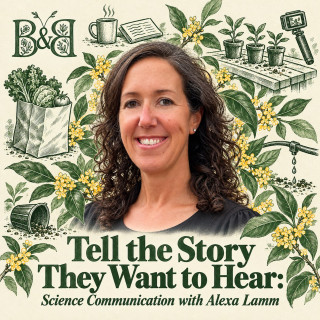
Tell the Story They Want to Hear: Science Communication with Alexa Lamm
S02:E12

Tell the Story They Want to Hear: Science Communication with Alexa Lamm

Athens, Georgia
Oct 11, 2026 • 55min 45s

Episode description

Tell the Story They Want to Hear: Science Communication with Alexa Lamm

Episode Description

Alexa Lamm was a 4-H kid who showed livestock and horses and fully expected to go to vet school. Then she realized she liked working with healthy animals, kids and producers a lot more than sick ones. She spent almost ten years as an extension agent just south of Denver, and it frustrated her for years that Extension kept calling itself the best-kept secret. Today she is a professor of science communication at the University of Georgia, and she has a claim every extension specialist should hear: Extension is the original science communication.

Ping brings the question she wrestles with herself. How do you show impact to people who don’t farm? Alexa’s answer is to tell the stories the public cares about, like water saved on farm that stays available for other uses, or produce on the shelf at a price a mom can balance a meal around. She lays out her four pieces of effective science communication (know your audience, know what they care about, deliver through a source they trust, and use the channel they already use), with a Georgia and Florida example that anyone who owns red and black will recognize. Then she explains why nursery and greenhouse producers want YouTube videos, and why, if scientists stay offline, someone else fills the space.

The second half turns to trust. Alexa puts public trust in science at about forty-three percent and says a lot of that is the scientific community’s own doing: unpublished null results, talk of fact and certainty, and emotion left out of everything. Ping offers a case from her own lab, a student’s Osmanthus fragrans study that found no germination and could only go out as a proceeding. Alexa shares the reason she gets up every morning and fights for science, the surgeon who saved her daughter’s life, and closes with advice for handling online critics, by way of celebrity chef Lazarus Lynch, and for early career scientists who know more about communicating online than they realize.

Listen Time: 55:46 Follow Along with the Transcript

In This Episode

Guest

Dr. Alexa Lamm, Professor of Science Communication, University of Georgia. She studies how people communicate about critical issues facing the agricultural industry, much of it in partnership with scientists. She grew up in 4-H, earned an animal science degree and a master’s in extension education, and was an extension agent in Colorado for almost ten years. She earned her PhD at the University of Florida and spent about ten years there, including about eight as an evaluation specialist, before coming to UGA eight years ago, originally as the evaluation specialist. With ag economists, she helped create an evaluation tool that about half of the United States now uses within their extension systems. Her lab, the Lamm Lab, hosts the AgriCurious podcast for early career scientists.

Host: Dr. Ping Yu, UGA Department of Horticulture

Main Topics

  • Welcome (0:00)
  • Meet Alexa Lamm (0:59). From 4-H and animal science to extension agent, evaluation specialist and professor of science communication
    • From animal science kid to extension agent (1:59)
    • Why evaluation became her focus (5:08)
  • Telling the stories of impact people care about (8:00). Why grower profit alone doesn’t move the public or decision-makers
    • A win-win-win (11:13)
  • Science communication as a two-way dialogue (12:10). Listening to producers, and what a pot Walmart won’t accept can teach a scientist
    • Knowledge passed down on the farm (15:06)
  • Four pieces of effective science communication (17:11). Know your audience, and know what they care about
    • A source they trust, on a channel they use (19:06)
  • Digital media and the rise of YouTube (22:05). How COVID changed outreach, and what producers want from video
    • Pork production, misinformation, and filling the space (25:33)
  • Why trust in science is at an all-time low (28:20). Null results, defensiveness, funding questions and the language of certainty
    • How scientists can rebuild trust (32:34)
    • A study that found no germination (35:15)
  • Emotion, storytelling, and starting with your why (37:01). Alexa’s own why, and why it builds trust with a room
    • The connection a machine cannot replace (41:10)
  • Measuring the impact of science communication (43:25). Knowledge gain, intent, behavior change and stories of impact
    • Controversial topics and online critics (46:24)
    • “I just delete the line” (49:10)
  • Advice for early career scientists (50:52)
    • Where to find Alexa’s work (53:03)
  • Closing (54:44)

Key Highlights

  • Extension is the original science communication (4:01). Alexa sees no real line between the two. What has changed is the public: people now vote on legislation that can block science or fund it, and regulations can block practices producers would love to use.
  • The best-kept secret (6:28). As an agent in Colorado, it frustrated her for years that Extension found the same people using its services over and over. Her diagnosis was that Extension couldn’t showcase its impact, and that sent her to a PhD in evaluation.
  • The mom buying groceries (10:40). Producers adopt a practice because it saves them money or makes them more, but a taxpayer hears that and thinks, “okay, so what?” Alexa’s alternative is the story the public cares about: water conserved on farm that keeps other resources open (9:34), and produce on the shelf at a price a family can afford.
  • The pot Walmart won’t take (14:07). A scientist recommends the most efficient container. The grower answers that the wholesaler won’t take it, because Walmart won’t accept a pot that deteriorates too quickly on its shelves. Listening to that answer and adapting the science is what Alexa calls true science communication.
  • Red and black, or orange and blue (19:41). Producers trust their local extension specialist, so a Georgia grower calls Ping and a Florida grower calls IFAS. If your work applies to both states, partner with someone at Florida to deliver it there.
  • Podcasts on the tractor (20:25). Producers have told Alexa they listen to podcasts driving the truck or out on the tractor. Others want a newsletter over coffee, social media, webinars or a face-to-face field day. Her rule is to meet people on the channel where they already are and not ask them to go somewhere new.
  • A scientist with a GoPro (23:38). Alexa says COVID changed outreach more than digital media did. In the nursery and greenhouse industry she sees producers asking for YouTube videos, even a scientist walking a greenhouse with a GoPro. Her combination plan: hold the field day, stream it on Facebook Live, and post it to YouTube for people to watch later.
  • Fill the space (27:03). If the scientific and agricultural communities aren’t present online, others fill the space. When a decision-maker searches a question about water use on farm, that other material is what shows up, and it looks very real.
  • Forty-three percent (29:12). Alexa puts public trust in science at about forty-three percent. Much of the reason, she says, is the scientific community’s own fault: defensiveness about results, null results that never get published (30:04), and questions about who funds the research (31:15).
  • Practicing medicine (33:10). Doctors talk about practicing medicine. They try a solution, see what happens and adjust. Alexa wants scientists to drop the language of certainty, fact and truth the same way.
  • A study that found no germination (35:15). One of Ping’s students found no germination in his Osmanthus fragrans study. With no significant results, a proceeding was the only way to get the work out. Alexa adds that publishing it also keeps someone else from spending the time and money to run the same experiment (40:38).
  • Her own why (38:23). Alexa’s daughter was born with a heart condition and had open heart surgery at two months old, and a second right after her second birthday. Fifteen or eighteen years earlier, Alexa learned, the science to save her would not have existed. She names her superhero, Dr. Mark Bleiweis of the University of Florida (39:09), and she opens talks to hundreds of people with that story because it builds trust.
  • Eighty percent of intention (44:12). About 80% of intention doesn’t follow through into full behavior change, which is why tracking runs to the six-, twelve- and twenty-four-month marks. The truer measure of impact, she says, comes from going back to the opinion leaders, the producers everyone else looks up to (45:04).
  • Delete, delete, delete (48:19). Her advice to scientists who can’t handle the heat online is that you don’t have to respond. Lean on your university’s communication folks instead. Celebrity chef Lazarus Lynch, a World Food Prize fellow who won Chopped twice, told one of her classes that he just deletes the line (49:57).

Key Quotes

“Extension is the original science communication, where we take information from the land grant university out to those who need it the most.” Dr. Alexa Lamm (4:01)

“tell the story they wanna hear, not the one you wanna tell, from the source that they trust on the channel where they’re already present.” Dr. Alexa Lamm, on the four pieces of effective science communication (21:26)

“Because humans are emotional, they’re not logical, and science talks to logic, numbers, facts, figures.” Dr. Alexa Lamm (34:10)

“I just delete the line.” Chef Lazarus Lynch, as Dr. Alexa Lamm recounts his answer to her class (49:57)

“There’s always people that can teach you something, and that might change your whole life.” Dr. Ping Yu, to early career scientists (52:53)

Educational Highlights

From one-way to two-way. Communication was originally defined as one person delivering a message and another receiving it. Alexa’s field has moved past that to a two-way dialogue: scientists share findings, listen to the end user, and adapt the science, in what she calls a continuous reciprocal relationship.

Knowledge passed down on the farm. Knowledge a farmer inherits from generation to generation usually has a scientific explanation for why it works, even when the farmer can’t give one. A scientist who listens can find that explanation and carry the practice to a whole bunch of other farms.

The four pieces of effective science communication. First, know your audience, and remember that the public is many audiences: a 20-something saving for a first home, a middle-aged woman with a family, a producer who has been doing it for 60 years. Second, know what they care about, whether economics, environmental sustainability, water use or recycling on farm, and build the message around it. Third, deliver it through a source they trust. Fourth, put it on the channel they already use. Alexa calls the audience the foundation, because it drives the other three.

Misinformation and disinformation. As Alexa explains them, one is intentional and one is not, and either can cause harm. Some misinformation traces back to a real journal article whose data was completely misinterpreted. Her two responses are teaching critical thinking and source checking, and being present online with good information.

Null results. A hypothesis that tests false is still a finding. Alexa wants journals to publish non-significant findings as readily as significant ones, because over time they are the record of what has and hasn’t changed.

How impact gets measured. Evaluation tools measure how much knowledge someone gained and their intent to use it. Follow-up observation at six, twelve and twenty-four months shows whether behavior actually changed. The same tools can put an economic value on information and measure emotional well-being, how much more secure or safe something makes people feel. With decision-makers, Alexa pairs the numbers, which they have to have, with the face, story, picture or video that shows what the numbers mean.

Opinion leaders. In every producer community there is one producer everyone else looks up to. If they adopt a practice, others will. If they decide not to, she says, you’re done. Going back to those producers and asking them to tell their stories is, for her, the truer measure of impact.

Genetic modification and genetic engineering. Alexa names GMOs, and now CRISPR and genetically engineered crops, as sticky spaces. The two terms sound similar but are different, and explaining the difference is part of the work. The lesson she takes from past mistakes is open transparency: anything that feels hidden needs to be more open.

Starting with your why. Before the content, tell the room why you are standing in front of them, why you care and why you study this. Alexa calls it making yourself vulnerable, which is not what grad school teaches, and she says it builds immediate trust.

Implicit knowledge. Early career scientists are digital natives. Alexa tells them they already know more about communicating online than she ever will, and that this implicit knowledge belongs in their jobs.

Resources & Links

  • Website: bandbpod.com
  • Lamm Science Communication Lab, University of Georgia: site.caes.uga.edu/lammlab (Alexa’s tip at 53:31: just Google Lamm Lab)
  • AgriCurious, the Lamm Lab’s podcast for early career scientists: site.caes.uga.edu/lammlab/agricurious-podcast (53:37)
  • Connect with Alexa on LinkedIn: @lexlamm (53:57)
  • Council for Agricultural Science and Technology (CAST), which Alexa recommends for its webinars and programs on communicating science: cast-science.org (51:50)
  • Pork production on YouTube: frame and sentiment analysis, by Anu Karki, Alexa Lamm and colleagues at Iowa State, UGA and NC State, in Frontiers in Communication (2025), the study Ping brings up at 25:33: doi.org/10.3389/fcomm.2025.1557633
  • University of Florida IFAS, the extension home Alexa mentions for Florida growers (19:46)

About Blooms and Beyond

Blooms and Beyond explores plant history, culture, and management through the lens of science. Whether you’re a commercial grower seeking practical solutions, a student exploring careers in horticulture, or simply someone who loves plants and their stories, there’s something here for you. Hosted by Dr. Ping Yu of the University of Georgia, each episode features interviews with experts who share enchanting stories, cutting-edge research, and practical wisdom from the world of horticulture.

Your benefit: After each episode, commercial growers will have at least one useful tip for their operation, and plant enthusiasts will have an interesting fact to share. That’s how we spread plant power to more people and make our environment a little better.

Credits

Host: Dr. Ping Yu Producer: Rich Braman Guest: Dr. Alexa Lamm, Professor of Science Communication, University of Georgia

Episode Release Date: October 11, 2026 Episode Length: 55:46

“Till next time, stay healthy and go plants!” 🌱
Comments0 Activity1 Chapters20 Transcript✓
Blooms and Beyond
Blooms and Beyond @bloomsandbeyond Oct 11, 2026
55:45 Tell the Story They Want to Hear: Science Communication with Alexa Lamm
S02:E12 Oct 11, 2026
Tell the Story They Want to Hear: Science Communication with Alexa Lamm
0 0 0
RSS Podcast feed

Listen on

HomeLinksCreditsMapThe Two-Spotted Cotton Leafhopper: An Urgent Conversation with Clemson's EntomologistsBotrytis Blight: Gray Mold, Calcium Shields, and Building a Better BoxThrips Parvispinus IPM with Dr. Alexandra Revynthi — Blooms and Beyond, S01E12Science Translators on the Front Lines: Urban Extension in Metro Atlanta — Blooms and Beyond, S01E11Georgia's Green Industry and the Power of Advocacy with Lanie RinerIt's Not Garden Therapy: The Real Science of Plants and People with Sheri DornThe Dream Team Behind CultivateDrones Take Flight in the Nursery: How Two Disciplines Built Something Neither Could Alone (Part 1)Drones Take Flight in the Nursery: RFID, Real-Time Inventory, and the Road Ahead (Part 2)From Cherry to Cup: The Science Behind Your Morning Coffee with Leo Lombardini, Blooms and Beyond, S02E05IPPS Southern Region: To Seek and to Share with Brie Arthur, Blooms and Beyond, S02E06The Beetle That Moved Into the Nursery: Managing Red-Headed Flea Beetles with Shimat Joseph, Blooms and Beyond, S02E07When the Plants Start Talking to You: Breeding New Ornamentals, Blooms and Beyond, S02E08Seven Out of 1,200: The Long Road to a Better Hibiscus, Blooms and Beyond, S02E09Apricot, Honey, and Sunshine: Breeding a Hardier Tea Olive, Blooms and Beyond, S02E10The Bald Cypress Tunnel of Love: Dave Creech and 40 Years of SFA Gardens (Part 1), Blooms and Beyond, S02E11The Camellia of 10,000 Flowers: Dave Creech and 40 Years of SFA Gardens (Part 2), Blooms and Beyond, S02E11Tell the Story They Want to Hear: Science Communication with Alexa Lamm, Blooms and Beyond, S02E12

Ping Yu

Powered by Castopod

Persons