Ping Yu: (music) Hello, everyone.
Download transcript (.srt)
0:00
0:05
0:12
0:13
0:15
0:25
0:36
0:44
0:52
0:54
0:58
0:59
1:06
1:08
1:13
1:16
1:22
1:24
1:26
1:31
1:39
1:43
1:52
1:59
2:08
2:12
2:20
2:31
2:33
2:39
2:44
2:46
2:51
2:53
2:56
2:57
3:01
3:09
3:16
3:23
3:31
3:34
3:41
3:44
3:49
3:55
4:01
4:08
4:16
4:19
4:27
4:34
4:43
4:51
4:54
5:04
5:08
5:14
5:24
5:35
5:45
5:50
5:59
6:10
6:16
6:20
6:22
6:28
6:35
6:36
6:38
6:43
6:48
6:54
6:59
7:00
7:03
7:07
7:10
7:20
7:29
7:35
7:37
7:38
7:42
7:45
7:55
7:57
8:00
8:03
8:08
8:19
8:29
8:31
8:35
8:35
8:41
8:48
8:51
8:52
8:54
8:59
9:01
9:09
9:14
9:22
9:27
9:28
9:31
9:34
9:44
9:55
9:58
10:06
10:09
10:16
10:19
10:27
10:31
10:40
10:48
10:56
10:58
11:06
11:09
11:13
11:13
11:19
11:27
11:30
11:35
11:42
11:43
11:53
11:54
11:59
12:06
12:10
12:21
12:30
12:31
12:34
12:37
12:42
12:47
12:55
13:03
13:04
13:15
13:21
13:24
13:34
13:36
13:40
13:47
13:58
13:59
14:03
14:06
14:07
14:13
14:16
14:20
14:29
14:33
14:38
14:43
14:45
14:49
14:59
15:03
15:06
15:16
15:24
15:28
15:37
15:41
15:47
15:52
16:01
16:11
16:21
16:27
16:37
16:40
16:49
16:51
16:58
16:58
17:06
17:10
17:11
17:18
17:29
17:31
17:32
17:37
17:40
17:42
17:44
17:46
17:56
18:05
18:05
18:10
18:15
18:22
18:24
18:31
18:39
18:46
18:48
18:50
18:52
18:57
19:06
19:08
19:12
19:18
19:26
19:33
19:38
19:41
19:45
19:46
19:51
20:00
20:07
20:10
20:12
20:19
20:25
20:33
20:39
20:41
20:45
20:46
20:54
20:54
20:57
21:00
21:02
21:05
21:12
21:19
21:21
21:22
21:26
21:35
21:36
21:38
21:38
21:42
21:49
21:59
22:05
22:15
22:22
22:33
22:37
22:40
22:46
22:56
23:00
23:09
23:12
23:21
23:24
23:31
23:38
23:46
23:57
24:05
24:14
24:16
24:26
24:33
24:42
24:47
24:48
24:49
24:50
24:51
24:54
24:58
25:02
25:04
25:14
25:15
25:25
25:33
25:33
25:41
25:41
25:47
25:53
25:58
25:59
26:00
26:06
26:16
26:21
26:31
26:35
26:42
26:47
26:50
27:01
27:03
27:10
27:11
27:14
27:23
27:27
27:34
27:43
27:43
27:52
27:55
27:59
28:03
28:11
28:18
28:20
28:29
28:39
28:49
28:57
28:57
29:01
29:10
29:12
29:18
29:22
29:30
29:40
29:48
29:54
30:01
30:04
30:13
30:22
30:31
30:32
30:39
30:42
30:46
30:56
31:05
31:09
31:11
31:15
31:21
31:31
31:32
31:32
31:39
31:48
31:57
31:59
32:03
32:09
32:17
32:19
32:26
32:34
32:38
32:47
32:56
33:04
33:06
33:10
33:13
33:21
33:24
33:26
33:30
33:37
33:46
33:56
34:01
34:10
34:18
34:27
34:32
34:42
34:44
34:51
35:01
35:11
35:15
35:23
35:33
35:35
35:45
35:56
36:03
36:07
36:17
36:19
36:27
36:29
36:31
36:32
36:37
36:41
36:42
36:52
36:57
36:57
37:00
37:01
37:11
37:19
37:24
37:28
37:38
37:44
37:45
37:46
37:57
38:03
38:06
38:07
38:09
38:13
38:23
38:34
38:35
38:45
38:49
39:00
39:02
39:09
39:17
39:20
39:21
39:25
39:27
39:35
39:45
39:46
39:50
39:56
40:05
40:09
40:19
40:20
40:28
40:35
40:38
40:46
40:48
40:51
41:01
41:10
41:11
41:21
41:24
41:32
41:43
41:52
42:02
42:05
42:06
42:15
42:25
42:29
42:31
42:42
42:43
42:44
42:47
42:57
43:01
43:03
43:06
43:15
43:18
43:24
43:25
43:36
43:41
43:44
43:45
43:54
44:04
44:07
44:12
44:20
44:23
44:25
44:35
44:36
44:45
44:50
44:58
45:02
45:04
45:14
45:16
45:19
45:22
45:25
45:33
45:36
45:39
45:40
45:44
45:53
46:02
46:03
46:13
46:21
46:24
46:32
46:42
46:50
47:01
47:07
47:10
47:20
47:22
47:28
47:33
47:40
47:50
47:56
48:05
48:06
48:14
48:17
48:19
48:23
48:26
48:29
48:32
48:36
48:43
48:51
48:55
49:03
49:03
49:05
49:10
49:14
49:15
49:18
49:20
49:21
49:23
49:33
49:36
49:46
49:48
49:51
49:57
50:01
50:06
50:07
50:10
50:12
50:20
50:21
50:24
50:25
50:26
50:31
50:39
50:45
50:45
50:46
50:48
50:49
50:52
51:03
51:13
51:18
51:26
51:31
51:34
51:43
51:47
51:50
51:56
51:59
52:05
52:08
52:17
52:18
52:23
52:31
52:37
52:42
52:42
52:52
52:53
52:58
52:59
53:00
53:00
53:03
53:13
53:24
53:27
53:31
53:34
53:37
53:41
53:49
53:52
53:55
53:57
54:02
54:09
54:09
54:17
54:23
54:25
54:29
54:39
54:42
54:43
54:44
54:44
54:52
55:01
55:07
55:13
55:23
55:24
55:25
55:27
Ping Yu: Welcome to the Blooms and Beyond podcast, a podcast that uncovers plant history, culture, and management through the lens of science.
Ping Yu: I'm your host, Ping.
Ping Yu: How's everyone doing today?
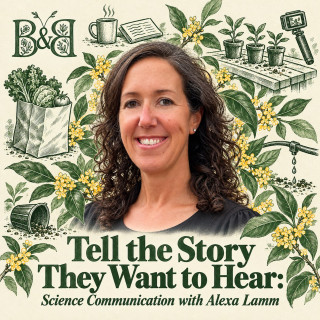
Ping Yu: I am doing great, great because here I have my dear colleague and friend Dr. Alexa Lamm from University of Georgia here
Ping Yu: with me today on this show to talk about the very interesting and exciting topic on scientific communication, which I am a big fan of that.
Ping Yu: She is definitely one of the rock stars in this field, and you're gonna have a glimpse of that too.
Ping Yu: And I know she has tons of interesting story and knowledge and experience to share, so I don't want to steal any more thunder from our speaker today.
Ping Yu: Let's just jump right into it.
Ping Yu: Without further ado, here is my conversation with Dr. Alexa Lamm.
Ping Yu: I hope you enjoy.
Ping Yu: (music) So hi, Alexa, welcome to the podcast.
Ping Yu: But first, let's start off with the introduction.
Ping Yu: Can you tell our audience a little bit about who you are and what you do?
Alexa Lamm: Thank you so much for having me here today.
Alexa Lamm: I really appreciate being invited and getting to be a part of this awesome podcast that you've started.
Alexa Lamm: I love listening to it myself.
Alexa Lamm: And a little about myself.
Alexa Lamm: I am a professor of science communication at the University of Georgia.
Alexa Lamm: I get to study how people communicate about critical issues facing the agricultural industry.
Alexa Lamm: And so a lot of that is in partnership with scientists like yourself.
Alexa Lamm: And so it's wonderful to get to come here and talk about that 'cause there are many ways in which we can effectively and not so effectively communicate
Alexa Lamm: about scientific advancements and some of the things that might hinder our ability to use science out in the field.
Ping Yu: Yeah, 'cause I still remember the first time I met Alexa during a meeting with the multi-state group.
Ping Yu: We're all kind of working in irrigation.
Ping Yu: But I was like, when you started to introduce of what you do, I'm like, "Oh my gosh, that's very fascinating."
Ping Yu: Because a lot of times, especially me with- as a extension specialist, I always try to find a way to, you know, help, well, improve the communication efficiency.
Ping Yu: And I was like, "That would be great."
Ping Yu: And I know you had a workshop with the growers and it just like, I want to be part of that.
Ping Yu: Anyhow, but did you grow up with the exposure to agriculture?
Ping Yu: Did you see yourself as a nature kid growing up?
Ping Yu: And how did you become interested in science communication?
Ping Yu: Did you know that's a thing when you grew up?
Ping Yu: Can you share just a little bit about your career journey?
Alexa Lamm: Yeah, of course.
Alexa Lamm: No, I was your typical animal science kid.
Alexa Lamm: I did 4-H when I was young, showed livestock and horses and wanted to be a veterinarian.
Alexa Lamm: So you know, I went off to college and got an animal science degree with every expectation that I would go to vet school.
Alexa Lamm: But I realized that I liked working with healthy animals and kids and producers a lot more than sick ones.
Alexa Lamm: And so I ended up getting a master's in extension education and was an extension agent for almost ten years working in the agricultural field in Colorado.
Alexa Lamm: So I really have Extension at my heart.
Alexa Lamm: It's been a part of my career, 'cause after that, I went and got my PhD at the University of Florida, and I was actually there.
Alexa Lamm: Don't hold it against me, all you UGA Dawg fans.
Alexa Lamm: I was there for about ten years before coming to UGA eight years ago.
Alexa Lamm: And it's interesting because I always have had Extension at the heart of all of my work.
Alexa Lamm: But now I can see that really, truly, Extension and science communication, they're not distinctly different.
Alexa Lamm: I mean, Extension is the original science communication, where we take information from the land grant university out to those who need it the most.
Alexa Lamm: I think it's just become a little more complex as the public has become more engaged in guiding legislation around scientific advancement, right?
Alexa Lamm: The funding of science, whether they want to use it or not.
Alexa Lamm: They question it based on pseudoscience and miscommunication and all this kind of crazy stuff that's out there on the internet they can access all the time.
Alexa Lamm: But they can vote for legislation that blocks our ability to, you know, utilize science or to fund science.
Alexa Lamm: And then also we have this whole policy dynamic and regulation around the use of scientific advancement especially in the horticulture industry, right?
Alexa Lamm: As we think about some of the practices we try to encourage as extensionists, and it's like, I don't know how many producers say, "Yeah, I would love to use
Alexa Lamm: that, but there are regulations blocking me."
Alexa Lamm: And so we need effective science communication between scientists and those decision-makers making those choices too, so that all of that's informed by actual scientific
Alexa Lamm: information and not what people think might be the truth.
Ping Yu: Well, yeah, there's a lot of fake, well, I would say pseudo or fake information out there.
Ping Yu: Especially I think the scientific communication, the topic that we're talking about now today is especially important at this AI era,
Ping Yu: where you basically think that you can get all this information with just a click, but you don't know, like, how much of that is science-based
Ping Yu: information and you cannot truly trust what you find with the one click, and you have to fact check with
Ping Yu: basically everything so that you're not making mistakes in a lot of things that you do.
Ping Yu: So what motivated you to pursue the PhD in agriculture, education and communication and focus on communication evaluation?
Ping Yu: Because, well, I am a extension specialist, but I know how important communication is in terms of deliver the information to our stakeholders.
Ping Yu: But one of the trick thing for us sometimes is how do we do the evaluation?
Ping Yu: How can we know if I'm a effective communicator myself?
Alexa Lamm: Yeah, no, that's a great question.
Alexa Lamm: And I mean, I mentioned that I was an extension agent for ten years, right, in Colorado, just south of Denver.
Alexa Lamm: And it frustrated me for years that we would always talk about Extension is the best-kept secret, right?
Alexa Lamm: We still say that.
Alexa Lamm: It's like we do all these amazing things.
Alexa Lamm: We put on all these fabulous programs and webinars, and we've expanded in this digital age.
Alexa Lamm: We're even creating AI-based chatbots that we can interface with.
Alexa Lamm: I mean, we're- we do so much as Extension, and yet we find the same people utilizing our services over and over.
Alexa Lamm: How do we reach the broader producer base that could utilize what we do?
Alexa Lamm: How do we reach the public?
Alexa Lamm: How do we get, you know, all this information out there?
Alexa Lamm: And a lot of that is because we were unable to showcase our impact.
Alexa Lamm: And like you just mentioned, we still struggle with that.
Alexa Lamm: And so I had a real passion for trying to figure out how we most effectively evaluate our programs, but evaluate them in the way that the public cares about
Alexa Lamm: and that decision makers care about, so that they will continue to fund and support Extension, which to me is essential in the science communication space.
Alexa Lamm: And so, you know, it keeps coming into question, is Extension really something of public value?
Alexa Lamm: Should tax dollars be supporting this, right?
Alexa Lamm: State and federal dollars.
Alexa Lamm: Well, if we can't show our impact, it's really hard to make that argument.
Alexa Lamm: And so that's why I pursued a PhD in that area.
Alexa Lamm: And then I did serve as an evaluation specialist in Florida for about eight years in that capacity and then came here to Georgia originally as the
Alexa Lamm: evaluation specialist.
Ping Yu: Yeah.
Ping Yu: (music) And you kind of mentioned about the impact.
Ping Yu: That's one of the big questions that every Extension people (laughs) kind of face or have to do.
Ping Yu: But from your perspective and experience, what are some of those impacts or evaluation critiques that are different from,
Ping Yu: you know, for instance, to deliver the right message that the politics makers or the general public care more than the educator like us
Ping Yu: care more about it?
Ping Yu: Can you kind of tell us a little bit about from that angle?
Alexa Lamm: Yeah.
Alexa Lamm: So I think oftentimes when we do extension programming, it's very producer forward, right?
Alexa Lamm: We're trying to help producers understand the new science and how it can be used in their facilities or their farms or their production units.
Alexa Lamm: And a lot of producers, I mean, that's their livelihood, right?
Alexa Lamm: That's their business.
Alexa Lamm: And so we focus on economic profitability.
Alexa Lamm: Like, you should adopt this because it will save you money or make you more money, right?
Alexa Lamm: Because that's what incentivizes people.
Alexa Lamm: They have kids they want to send to college too, and that is a viable reason for them to want to know if I change everything I'm doing and
Alexa Lamm: adopt this new practice, it will result in something positive for me.
Alexa Lamm: I think because of that, then we talk about impact of our programs as, well, these producers are making this much more money or they're saving this much money.
Alexa Lamm: But the general public and the policy makers, they don't really connect with that, right?
Alexa Lamm: It's like, okay, so what?
Alexa Lamm: So all of my tax dollars are going to help a farmer make more money?
Alexa Lamm: Like, that doesn't sit with me.
Alexa Lamm: Where if we can talk about environmental sustainability, how much water is saved that can then be used for other sources or other resources that maybe recreational facilities
Alexa Lamm: that they utilize will be viable and open because water use has been reduced because of like the irrigation practices that you develop that help conserve water on farm
Alexa Lamm: and then save water for other things.
Alexa Lamm: We have to tell stories that the public cares about or the decision-maker cares about, and honestly, the decision-maker typically cares about whatever their constituents care about, right?
Alexa Lamm: Because they're representing them, and they should.
Alexa Lamm: And so we really need to get in the minds of the, like it's not always the user of science that benefits.
Alexa Lamm: We have to talk about what are those benefits beyond that.
Alexa Lamm: And so I think it's important for producers to gain knowledge and to have an intent to engage in a certain behavior.
Alexa Lamm: And we can measure those things with evaluation tools at extension programs.
Alexa Lamm: But I also think it's important for us, collectively us, the scientific community along with the ag community, to really think about, like, well, how is this bettering society?
Alexa Lamm: How does this make sure that produce is on the shelves when a mom is going to buy her groceries, right?
Alexa Lamm: How is this ensuring that those groceries are not so expensive that she can't, like, balance that meal for her family?
Alexa Lamm: Those are the things that she cares about.
Alexa Lamm: And so I think we need to think beyond, like, okay, we do have a target for scientific adoption, but then who benefits from this?
Alexa Lamm: And we need to tell those stories of impact.
Alexa Lamm: And that is when people will really care.
Ping Yu: Yeah.
Ping Yu: 'Cause I think that's a great tip for me, for a lot of folks like me.
Ping Yu: Basically what we need to do is we need to think beyond the stakeholders we are serving now.
Ping Yu: They are part of our society.
Ping Yu: What they are doing is a big puzzle piece in this whole society.
Ping Yu: So what we are doing kind of benefit them, but also benefit the whole society.
Alexa Lamm: We can all win, right?
Alexa Lamm: It can be a win-win-win, and I haven't talked to a single producer that doesn't care about the environment, that doesn't care about where their product ends up and
Alexa Lamm: that it benefits someone, right?
Alexa Lamm: It's like they go into farming and production agriculture because they care.
Alexa Lamm: But I think, like you said, we kind of stop at our first stakeholder, and we don't necessarily think about that long term.
Alexa Lamm: But I promise you, when you sit down and you talk to those producers, they care.
Ping Yu: (music) So let's circle back a little bit for folks that, whom may not be so familiar with science communication.
Ping Yu: How do you define that, and especially within the context of agriculture and environmental science that we're all in right now?
Alexa Lamm: Yeah, no.
Alexa Lamm: Science communication seems like pretty easily defined, right?
Alexa Lamm: It's like transferring information from one person to another, right?
Alexa Lamm: There's a, somebody who's delivering the message, and there's somebody who's receiving the message.
Alexa Lamm: That's kind of how communication has originally been defined.
Alexa Lamm: However, we've kind of moved beyond that to more deeply think about the, a two-way dialogue, right?
Alexa Lamm: It's like it's one thing for the scientific community to stand in front of a group of producers and share scientific findings and say, "You need to utilize these and
Alexa Lamm: adopt these, and this is how."
Alexa Lamm: It's a whole 'nother for them then to listen to producers who say, "Well, that's great, but I have this system already in place in my greenhouse, and
Alexa Lamm: adopting that practice is not gonna work with the drip irrigation that's already existing for XYZ.
Alexa Lamm: Can we make a few tweaks here?
Alexa Lamm: And maybe because it's not, it might not be quite as efficient in saving water, but I'm gonna be able to use it without replacing everything in my irrigation system."
Alexa Lamm: Then the scientist can say, "Yeah, we can make a few tweaks.
Alexa Lamm: Let's try ABC instead of XYZ."
Alexa Lamm: And then it, so it becomes a two-way dialogue, right, between the end user and the scientist and the s- or the scientific team.
Alexa Lamm: And so then science communication is really evolving more collectively than in that one way traditional sense of we are the deliverers of science
Alexa Lamm: to the end user.
Alexa Lamm: You should love it because of here's all the reasons why.
Alexa Lamm: And so it becomes more of this kind of interface, right?
Alexa Lamm: It's the same thing with regulation.
Alexa Lamm: We can come up with science all day long, but if the producer says, "Well, I think that's great.
Alexa Lamm: I would love to grow in this container.
Alexa Lamm: However, Walmart will not accept that," right?
Alexa Lamm: "My wholesaler won't take it because Walmart won't accept that pot because it deteriorates too quickly on their shelves, and so I can't grow in that, even though you tell
Alexa Lamm: me it's the most efficient, effective growing mechanism."
Alexa Lamm: Or maybe their machinery doesn't handle that pot well, and it deteriorates, right?
Alexa Lamm: So they can kind of tell us back and forth that like, yeah, like pie in the sky idea's great.
Alexa Lamm: Here's reality, right?
Alexa Lamm: Let's ground it somewhere in between and find a scientific advancement that helps us all.
Alexa Lamm: And so we really need to take the time to share our science but also listen to the end user and take that in and adapt our science effectively
Alexa Lamm: to help them the most, and that should be a continuous reciprocal relationship.
Alexa Lamm: That's true science communication.
Alexa Lamm: And the other thing we have found when you really open yourself as the scientist, opens yourself, is that indigenous knowledge that the farmer has that's been passed
Alexa Lamm: down from generation to generation, there is usually a scientific explanation for why it works.
Alexa Lamm: They can't tell you that, but they know it works, right?
Alexa Lamm: And so we can also learn a lot as a scientific community by listening to what that knowledge, that passed down knowledge is from the community that we're serving, and
Alexa Lamm: kind of adapt and utilize it in our science to make everything better.
Alexa Lamm: So yeah, like, that's a really neat way of thinking about science communication too.
Alexa Lamm: It's not always, right, like the ivory tower, we know best, here do good things.
Alexa Lamm: Like it's, it is about that kind of like continual conversation about what works, and maybe they don't know why, but it does.
Ping Yu: Yeah, and also that's just give you- you just listed a perfect example for us to kick in and that will benefit the, what involved science itself, because
Ping Yu: while the growers might have all those generations of wisdom of how this works for them, they may not know the science behind it, and that's a opportunity for
Ping Yu: you to, you know, to dive into it and say, "Oh, why, this is why it works."
Ping Yu: And you may develop a strategy that will, more people can adapt it with your, with the science that you have, well, with the science solution that you have
Ping Yu: developed from whatever they are working.
Alexa Lamm: Exactly, 'cause maybe it's been working on this one farm because they've had this knowledge over time, but you can then help a whole bunch of other farmers based on
Alexa Lamm: that, you know, transferring that information.
Alexa Lamm: So yes, there's a lot of opportunities when we engage in more effective, like two-way dialogue.
Ping Yu: Yeah.
Ping Yu: I always find myself learning a lot from the growers that I serve, and I (Alexa Lamm: Too) was like, oh my gosh, they are, they are just so
Ping Yu: knowledgeable on certain things that I was like, "What?"
Alexa Lamm: Yeah, absolutely.
Ping Yu: (music) So we talk about some of the effective science communication.
Ping Yu: What are some core principles of effective science communication, particularly if we're talking about topics or complex topics to,
Ping Yu: let's say, lay audience?
Alexa Lamm: Yeah, that's a great question.
Alexa Lamm: There are really four foundational pieces to effective sci- in my mind and from my research.
Alexa Lamm: One, first you have to know who your audience is.
Alexa Lamm: Like, is it the producer?
Alexa Lamm: Is it a certain segment?
Alexa Lamm: We talk about the public all the time, right?
Alexa Lamm: But the public is made up of so many different people, and what they care about is, you know, the 20-something-year-old that just graduated from college and is just trying
Alexa Lamm: to make it in their first job and save up to buy their first home cares about a lot different things than I do as a middle-aged woman with a
Alexa Lamm: family, right?
Alexa Lamm: Versus someone who is nearing, you know, retiring and...
Alexa Lamm: So different people are looking for different things, and that is even within our farming communities, right?
Alexa Lamm: Like the young producer is looking for different things than somebody who's been doing it for 60 years, right?
Alexa Lamm: And they need different resources and different things.
Alexa Lamm: So the very first thing in effective science communication is getting, like identifying who your audience is and then getting to know them.
Alexa Lamm: Listening to them, getting to know what they care about, finding out where they go for information, who they rely on, right, and who they trust.
Alexa Lamm: Because next is you gotta know what they care about so that the message you're sharing resonates with them, right?
Alexa Lamm: Is it, are they driven by economics?
Alexa Lamm: Are they driven by environmental sustainability?
Alexa Lamm: Like, what is it?
Alexa Lamm: Are they looking to decrease water use or enhance their recycling efforts on farm?
Alexa Lamm: Like, what is it that's driving them, and how can I then create a message or a webinar or whatever that's gonna resonate with that, right?
Alexa Lamm: And how do I bring the right people to the table?
Alexa Lamm: Because the source is also really important, okay?
Alexa Lamm: 'Cause we think as scientists that we're the best deliverers of scientific information, especially if it's coming out of our labs.
Alexa Lamm: But honestly, we trust, different audiences trust different sources of information, and they rely on them differently.
Alexa Lamm: So I talk to producers all over the US, and a lot of the time they will tell me that they trust their local extension specialist.
Alexa Lamm: So like here in Georgia, I am sure you are their go-to person, right?
Alexa Lamm: But not necessarily in Florida, right?
Alexa Lamm: They're not gonna call you, especially if you're wearing red and black, right?
Alexa Lamm: They're going for orange and blue.
Alexa Lamm: (Ping Yu laughs) They're calling the University of Florida, IFAS, their local extension agent, right?
Alexa Lamm: And so you might wanna partner with someone, maybe your stuff applies to both Georgia growers and Florida growers.
Alexa Lamm: Partner with somebody at Florida that can then deliver the message there to those producers because they trust them and they think that they know more about their farm,
Alexa Lamm: and they probably do, right?
Alexa Lamm: It's valid in who we trust.
Alexa Lamm: The final piece to that puzzle, so I said audience, know your audience, what they care about, so create a message they care about, deliver it by a source that
Alexa Lamm: they trust, and then the final piece is it needs to be on the channel that they use.
Alexa Lamm: So for instance, this podcast is awesome, and there are a lot of producers that have told me they love podcasts because when they're driving in the truck or they're
Alexa Lamm: out on the tractor or they're in the farm, they just plug in their headphones, and they can just listen, right?
Alexa Lamm: They don't want a huge long email newsletter anymore.
Alexa Lamm: They want the podcast 'cause they can just listen to it and hear all the great stuff that you're sharing.
Alexa Lamm: It's awesome.
Alexa Lamm: But there are some that just want the email newsletter that they can read when they have a moment or every morning over their coffee or once a week or
Alexa Lamm: whatever.
Alexa Lamm: They know they're gonna get this newsletter, and they're gonna look at it.
Alexa Lamm: And there are others that want social media pushed to them.
Alexa Lamm: There are others that want webinars.
Alexa Lamm: A lot of producers want face-to-face contact.
Alexa Lamm: They love that traditional face-to-face extension field days and getting together.
Alexa Lamm: So you also have to know what their method of receiving information is.
Alexa Lamm: So those are kind of the four pieces.
Alexa Lamm: Know your audience.
Alexa Lamm: That's the foundation of it all because that's gonna drive the other three, right?
Alexa Lamm: What they care about, the message, tell the story they wanna hear, not the one you wanna tell, from the source that they trust on the channel where they're already
Alexa Lamm: present.
Alexa Lamm: Don't ask them to go somewhere new.
Ping Yu: Yeah.
Ping Yu: It's funny that you said all those principles.
Ping Yu: It just basically similar to the message that I got from the, a general communication.
Ping Yu: There was one kind of course from Harvard that I tuned into maybe two years ago about communication, and then the
Ping Yu: first principle from that is know your audience every time.
Ping Yu: (music) I'm glad you mentioned some of the digital media that people are using, including podcasts, webinars,
Ping Yu: and there's, like, Facebook and other media platform that people are getting information out.
Ping Yu: But from your experience, how has the explosion of digital media changed the way that we communicate science, and what changes, what challenges does
Ping Yu: it create for us as communicator?
Alexa Lamm: Gosh, that's a great question, and it has changed the landscape.
Alexa Lamm: I would say even more than just the explosion of digital media, COVID changed the landscape.
Alexa Lamm: When we were kind of forced into utilizing it, pre-COVID, we were kind of dabbling, and Extension was exploring its use as an option to kind
Alexa Lamm: of reduce costs and try and alleviate the pressure to travel a lot.
Alexa Lamm: But then COVID kind of thrust us into, like, this is how we communicate because it's the only way to communicate, and now because people adopted
Alexa Lamm: it more readily during that time, like, we can continue to use it.
Alexa Lamm: I mean, the farmers I work with, it's just as easy to get them on a Zoom screen to have a conversation as it is to get them face-to-face anymore
Alexa Lamm: because it's less time, right?
Alexa Lamm: So I do think it has changed the way that we communicate science in that it has opened the doorway for a lot more.
Alexa Lamm: And it also means that less people are gonna show up at the face-to-face stuff because we're all really busy, and we see other ways of obtaining information.
Alexa Lamm: So one of the things I've noticed, especially in, like, the nursery greenhouse industry, this space is the use of YouTube.
Alexa Lamm: So a lot of producers, they want videos from folks like you on YouTube explaining, like, how a scientific advancement or something they can do.
Alexa Lamm: They even want you in a greenhouse with a GoPro, like, so they can just watch the video and listen to you talk rather than necessarily being there.
Alexa Lamm: And even if you are there doing, like, a field day, also projecting it that way through Facebook Live and then posting it on YouTube later, you will have a
Alexa Lamm: bigger reach than ever before.
Alexa Lamm: And so I think that is how digital media has really helped us do a better job of communicating science, in that we can have a bigger reach, we
Alexa Lamm: can get to more people, but we really have to think strategically about it and do some things ahead of time to set ourselves up for success.
Alexa Lamm: I think the biggest thing is when we choose not to do the traditional things because the digital media is easier, right?
Alexa Lamm: So if a scientist decides, like, "Well, field days are a lot of work.
Alexa Lamm: I have to set it up.
Alexa Lamm: I have to find a facility.
Alexa Lamm: I gotta do lunch.
Alexa Lamm: I gotta get people here.
Alexa Lamm: I have to think about reimbursing for mileage, if that's even a possibility.
Alexa Lamm: Like, how am I..."
Alexa Lamm: You know, when the option is that they could do a webinar for an hour.
Alexa Lamm: Like, you know, it's hard.
Alexa Lamm: It's hard to make those choices, but you can do, you can do kind of a combination thing where you're doing it live face-to-face, but you also have
Alexa Lamm: a digital strategy.
Alexa Lamm: Or maybe you can't get everybody there together, but you can go into your research greenhouse or whatever and video and do that and talk to people, even on Facebook
Alexa Lamm: Live and have them interface with you, but then take that recording and put it on YouTube so that somebody can watch it when they have the time available to
Alexa Lamm: do it.
Ping Yu: I'm glad that you mentioned the YouTube, and I came across one of your studies on the pork production on YouTube.
Alexa Lamm: Mm-hmm.
Ping Yu: Can you tell us a little bit more on that, and how do you think the medium shapes the producer's knowledge gain?
Ping Yu: And are there any way that you can trace back and evaluate their knowledge gain or even behavior change?
Ping Yu: That's just a term that every Extension people would say.
Alexa Lamm: Yeah.
Alexa Lamm: That's a great question.
Alexa Lamm: The article you're referring to was one we did as part of a project funded by the National Pork Board.
Alexa Lamm: They were really interested in communicating more effectively about pork production methods and trying to get the public to understand some of the sustainability efforts and
Alexa Lamm: the animal welfare efforts that the industry undertakes 'cause there's a lot of misconception out there.
Alexa Lamm: And I do think that's something that the digital age, Ping, has, like, really brought in, right, is this whole idea of pseudoscience, misconception, false information that
Alexa Lamm: is presented very similarly to scientific information.
Alexa Lamm: You talked about AI and, like, typing in and getting your answer, but you can't really always trust that answer full stop, right?
Alexa Lamm: We need to do some source checking and identifying source credibility.
Alexa Lamm: Now, that being said, though, so we are in competition, right?
Alexa Lamm: But that being said, we can look at, more than ever before, what those that may not agree with us think and believe
Alexa Lamm: because they are readily out there, right?
Alexa Lamm: If the scientific community, if the agricultural community chooses not to be present, there will be others that fill the space, right?
Alexa Lamm: Like- (Ping Yu: Mm-hmm)
Alexa Lamm: And then that's what when you search, you find.
Alexa Lamm: And so when the public, when the decision-maker goes to search, they have a question about, like, water use on farm, if we don't have good stuff, the other stuff
Alexa Lamm: will show up, and it looks very real and very reliable.
Alexa Lamm: And so, one, we've got to teach people critical thinking skills, (laughs) like the ones (Ping Yu: Yes) you talked about earlier, right?
Alexa Lamm: That it- we do need to look into credibility and find out who the source was, and is this a reliable source of information, and kind of track back
Alexa Lamm: to where it came from.
Alexa Lamm: Because sometimes the misinformation out there, they track back to a journal article, but they just completely misinterpreted the data, right?
Alexa Lamm: And it- and I don't think that it's always intentional.
Alexa Lamm: I think that sometimes there's disinformation and misinformation.
Alexa Lamm: And disinformation and misinformation means one's intentional and one's not.
Alexa Lamm: Either way, it can cause harm, and so we need to be, like, teaching people how to think critically about what they find online.
Alexa Lamm: But we also have to be present with the good stuff or, like, there's only the bad stuff available.
Alexa Lamm: So it's kind of filling that space too.
Ping Yu: (music) You have worked with studies examining public decision-making about science topics.
Ping Yu: And I know there's a lot of folks out there, like you said, they are sourcing information online on YouTube, but what kind of insights
Ping Yu: that you can share with us of how people make decisions when they receive scientific information, and how we as scientists can build
Ping Yu: trust with those diverse audience who might be skeptical of scientific message?
Alexa Lamm: Yeah.
Alexa Lamm: So it's really an interesting time.
Alexa Lamm: I just was giving a presentation last week at K-State on science communication and shared with them that, you know, we're at a time where trust
Alexa Lamm: in science is at an all-time low.
Alexa Lamm: It's about forty-three percent of the general public will report that they trust science, and that's scary, right?
Alexa Lamm: That's like, wow, what do they not trust about us?
Alexa Lamm: But honestly, when you dig deeper into the literature, you find that they believe that scientists have their own agenda, right?
Alexa Lamm: That we only ask the questions that we're curious about, and then we build our experiments based on what we want to find, not leaving ourselves open to
Alexa Lamm: the possibility of new information emerging or things that contradict what we say.
Alexa Lamm: And I'll be honest with you, a lot of that is our fault, the scientific community's fault.
Alexa Lamm: One, we like to think we're pretty darn smart and that we're right all the time, and how dare you question science, right?
Alexa Lamm: We get defensive about our results.
Alexa Lamm: But we also, sometime, somewhere along the way decided to stop publishing like null results, right?
Alexa Lamm: We test a hypothesis, and only if we find something where the hypothesis is proved to be true do we publish it, right?
Alexa Lamm: It's like, I don't know how many times I've heard faculty say to a graduate student, "Well, it's unfortunate that this didn't result in any significant findings because now you
Alexa Lamm: can't publish it."
Alexa Lamm: And it's like, well, isn't the fact that we tested a hypothesis and it didn't prove to be true a finding?
Alexa Lamm: Like, and I think that's how the public thinks about science.
Alexa Lamm: It's like, well, why are we only hearing about the significant results?
Alexa Lamm: Why are we not hearing about all the other science that goes on that proves that what the scientists thought was true isn't true, right?
Alexa Lamm: It's like, so we've kind of created this space where it's like, all right, we're perceived as only asking questions we're interested in, not the ones that they care about.
Alexa Lamm: And then when it doesn't work out the way that we think that it should, we don't publish it.
Alexa Lamm: We don't talk about it.
Alexa Lamm: And so it's kind of like, well, would I trust that too?
Alexa Lamm: And then when you look at funding mechanisms and who's funding different things, it comes into question too.
Alexa Lamm: Like, well, if the Agricultural Commodity Board that you're studying is funding this, then are they informing your research findings or the way that you're interpreting your
Alexa Lamm: results?
Alexa Lamm: Right?
Alexa Lamm: So we kind of hear sometimes like, "Oh, we believe they're in the pocket of Big Ag," right?
Alexa Lamm: Like, and we hear those kinds of things, and scientists are brought into question online, and social media influencers are trying to entice followers, and they do that by
Alexa Lamm: asking provocative questions that will get people emotionally connected to their pursuit or their agenda.
Alexa Lamm: And then the scientific community doesn't do that, right?
Alexa Lamm: Because we try to remove emotion from everything.
Alexa Lamm: We try to say, "Well, no, it's scientific fact, it's scientific truth, it's grounded in research."
Alexa Lamm: But then the needle moves, and the science changes and shifts, and it's like, well, you said that was fact ten years ago, and now we have new technology that's
Alexa Lamm: proven that's not the case anymore.
Alexa Lamm: And so like, is it really fact or is science like a movable thing?
Alexa Lamm: So we've given the public and decision-makers as a part of that group a lot of reasons not to trust science.
Alexa Lamm: So your second part of your question was, how do we build that back?
Alexa Lamm: One, I think we need to be more transparent about what we do, how we do it, why we ask the questions we do, and what the results are.
Alexa Lamm: I think our journals need to publish non-findings just as much as publishing significant findings, like non-significant and significant findings.
Alexa Lamm: We shouldn't be removing the non-significant stuff from the conversation because that is the proof of like over time, right?
Alexa Lamm: Things haven't changed versus have.
Alexa Lamm: I think we need to stop talking about scientific fact and truth.
Alexa Lamm: We- You know, you go to the doctor, and they talk about practicing medicine.
Alexa Lamm: "We figured out this is what we think is wrong with you, so we're gonna try this solution, see what happens, and then we'll come back together and
Alexa Lamm: see if we need to adjust or adapt that, right?"
Alexa Lamm: They never talk in like medical certainty.
Alexa Lamm: But yet for some reason in the scientific community, we do that.
Alexa Lamm: And I think we need to talk more about like the advancements of science and how it shifts and changes, and what we learn leads to better learning, and as
Alexa Lamm: we create more machines and even AI, right, we can do things with an efficiency that we couldn't even just five years ago, let alone twenty years ago.
Alexa Lamm: And so I think we need to stop talking in like scientific certainty, fact, truth, because truth is really kind of one of those like kind of gray areas, right?
Alexa Lamm: What's true for me may not be true for you, and we need to be more okay with that.
Alexa Lamm: And that we can shout science all day long, and somebody can know it and be informed, and yet still choose to do what they see as right for them.
Alexa Lamm: Because humans are emotional, they're not logical, and science talks to logic, numbers, facts, figures.
Alexa Lamm: And so we need to bring, finally my last point here, we need to bring more emotion, more storytelling to science.
Alexa Lamm: And I think people like you doing this podcast, bringing different groups on to tell their stories.
Alexa Lamm: I love when we talk about scientific adoption and impact to not always talk about like generalizable large numbers, but rather, here is a producer that adopted
Alexa Lamm: this practice.
Alexa Lamm: This is the challenges they faced, these are how they overcame them, and this was the end result of their product and their success long term.
Alexa Lamm: That resonates more with other producers as well as the public and decision-makers than any like generalizable fact figure ever will.
Alexa Lamm: And so we need to bring that human emotional component back to, like, not only communicating about science, but also
Alexa Lamm: its impact (Ping Yu: Yeah), telling those stories.
Ping Yu: Yeah, I feel the same because, like you said, the non-significant results are never get published.
Ping Yu: One of my students, they- he did a study on Osmanthus fragrans, and one of the things that he found is that there's no germination for whatever
Ping Yu: he has done.
Ping Yu: And so we ended up having to, well, the most part, well, we were like, okay, now I don't think the, any journal article gonna accept the
Ping Yu: fact that we don't have any significant results on that, but we can only do, what we could do to still deliver the information
Ping Yu: to whoever who might be thinking that's useful is through a proceeding, which kind of discouraged him.
Ping Yu: But anyhow, that's the only gateway we can do right now.
Ping Yu: But I agree with you that there are a lot of study that, well, without the significant results, but they are still very valuable information that
Ping Yu: needs to be getting out there.
Ping Yu: And also, I think one of the misconception from us as scientists and also the general public is that science is science.
Ping Yu: It's 100% right.
Ping Yu: It's not changeable.
Ping Yu: It's just there.
Ping Yu: But I see science as a moving piece.
Ping Yu: I think science advance will evolve over time.
Alexa Lamm: Yes, I agree.
Alexa Lamm: And you know, we do talk about confidence intervals and all of that, and we acknowledge there's limitations, but then when we go and share it, it's like, well,
Alexa Lamm: this is our finding, so this is what it implies and this is our recommendation and...
Alexa Lamm: Right?
Alexa Lamm: So it is a tricky one.
Alexa Lamm: It is tricky.
Ping Yu: (music) I love the way that you mentioned that we need to bring the human part more to the
Ping Yu: science or scientific communication and add more emotion in there instead of just logic alone.
Ping Yu: Can you tell us a little bit more about what, why the...
Ping Yu: Well, can you talk about the role of emotion in science community?
Ping Yu: And give us an example, if you have one, of how that can shape the reception from the audience we're talking to of
Ping Yu: better receiving the communication from science instead of just using the logic alone.
Alexa Lamm: Sure.
Alexa Lamm: I'd be happy to.
Alexa Lamm: One of my biggest suggestions when you're walking into a room or providing a program for a group that you're, you maybe don't have trust with already, right,
Alexa Lamm: is starting your, like, not just jumping right into the content, but starting with your own why.
Alexa Lamm: Like, why are you standing in front of them that day?
Alexa Lamm: Why do you care about this?
Alexa Lamm: Why are you studying this?
Alexa Lamm: Because people resonate with emotional connection, right?
Alexa Lamm: So I have a lot of reasons why I do what I do, but most deeply in me is I believe strongly in science and
Alexa Lamm: scientific advancement and the funding of science because my daughter was born with a heart condition, and she went, underwent open heart surgery when she was just
Alexa Lamm: two months old.
Alexa Lamm: And I found out as a scientist digging deeply into the literature, that if she had been born just fifteen, eighteen years prior, she never would've survived
Alexa Lamm: because the scientific advancement to save her life was not available.
Alexa Lamm: And it's because there are faculty at the University of Florida and around the world studying pediatric cardiology that there is the science available
Alexa Lamm: to literally save my daughter's life, and it did.
Alexa Lamm: She had a second open heart surgery right after her second birthday for another reason that was also successful.
Alexa Lamm: So when I think about my superhero, the person I look up to the most, his name is Dr. Mark Bleiweis, and he is a professor at the University of
Alexa Lamm: Florida, and he has saved my little girl.
Alexa Lamm: And that's enough, right?
Alexa Lamm: That's enough for me to get up every morning and fight for science.
Alexa Lamm: And it's not just medical science, right?
Alexa Lamm: For me, it's agricultural science because I've also seen misinformed regulation take down farmers' right to farm.
Alexa Lamm: And it comes from decision-makers that are informed by a public that are completely misinformed about the scientific backing of agricultural
Alexa Lamm: production techniques.
Alexa Lamm: And so I have a passion for that, right?
Alexa Lamm: But I will start a conversation or a presentation to hundreds of people with my own why.
Alexa Lamm: And it's making yourself vulnerable and emotional and sharing personal things like I just did with you, that then builds immediate trust with people because it's like, "Okay, I get
Alexa Lamm: why she's here, I get why she cares, and it's worth listening to."
Alexa Lamm: We- if we expect other people to feel emotionally connected to the information that we are providing them, because that's what actually changes decision-making, is emotion, not logic, right?
Alexa Lamm: They go hand-in-hand.
Alexa Lamm: Then we have to be willing to be open and honest about our own emotional connection to the information.
Alexa Lamm: Like I can tell even you telling this story about your grad student, Ping, that it's painful for you that he went through all of this and then struggled
Alexa Lamm: because he deserves to be published because he did all this work.
Alexa Lamm: Besides the fact that you don't want somebody else now to go and waste all this time and money conducting this same experiment, knowing full well from your own lab
Alexa Lamm: that that is not gonna germinate, right?
Alexa Lamm: So that knowledge needs to get out there.
Alexa Lamm: So, I think when we start sharing like why we do what we do, and resonating with people and connecting emotionally, but then talking about scientific findings and
Alexa Lamm: how they can help society, and telling not only stories about the people we work with, but stories about ourselves, that can help build trust.
Ping Yu: Yeah.
Ping Yu: I really appreciate that you shared that, and I have come across some other guest speakers in, on the podcast sharing their personal stories like
Ping Yu: this, and I just find fascinating.
Ping Yu: And that's one of the reasons why I'm doing this podcast, and I know it's a lot of work, but I really enjoy it because as a scientific community,
Ping Yu: as us, especially agriculture, we have tons of those intriguing stories from a lot of different people, but our story was definitely not
Ping Yu: being told enough to the general public, and our impact to the whole society was underestimated for a lot of reasons.
Ping Yu: And you know, at the end of the day, everybody has their own family, and they have the reason to do certain things with their own logic behind
Ping Yu: it, but we're human.
Ping Yu: It's emotion.
Ping Yu: It's those stories that connect us as a human, as a species on this planet that other planet doesn't have.
Ping Yu: So I think no matter how AI advanced down the road, the core thing that distinguish us with other
Ping Yu: is the connection, is the emotion that we have.
Ping Yu: So thank you for sharing that.
Ping Yu: I think that's just one of the fascinating thing about us as a human, as a society, that we share and that make us unique.
Alexa Lamm: Yeah.
Alexa Lamm: Absolutely.
Alexa Lamm: And you can't replace that, right, with a machine.
Alexa Lamm: You can't replace that connection, and we need to use it to our advantage because I will tell you that advocates that are anti-production agriculture or really
Alexa Lamm: anti-whatever they choose, they use emotion, right?
Alexa Lamm: (chuckles) They use stories.
Alexa Lamm: They elicit anger and fear.
Alexa Lamm: And I'm not saying the scientific community should do that, but there's no reason why we should always be separating ourselves from the emotional connection that we have
Alexa Lamm: to the work we do and to each other, just like you said.
Alexa Lamm: But it means making ourselves vulnerable, and that is not what we are taught to do in grad school, right?
Alexa Lamm: But it is important.
Ping Yu: (music) So in terms of the science communication effort, how do you
Ping Yu: assess that, and what kind of metrics or indicators do you use?
Alexa Lamm: That's a great question.
Alexa Lamm: We do have tools.
Alexa Lamm: We have quantitative tools like common measures type of tool that can assess public value of a program, of an extension program.
Alexa Lamm: So how much knowledge was gained by the receiver of the information, what is their intent to use that, and then even following up metrics, observational metrics over
Alexa Lamm: time to see if that behavior was altered, right?
Alexa Lamm: And that takes a lot of tracking at the six-month, twelve-month, twenty-four-month mark.
Alexa Lamm: A lot of people will commit to doing something, but we know about 80% of intention doesn't follow through in full behavior change.
Alexa Lamm: But we can also assign economic values to information.
Alexa Lamm: We can ask people to do that.
Alexa Lamm: Most people know if some information will lead to an economic loss or gain for them, if they are gonna save money or have more
Alexa Lamm: resources.
Alexa Lamm: But we can also measure levels of emotional well-being, so how much something will help them feel more secure, more safe.
Alexa Lamm: So we have some of those measures available that are being used more and more by Extension.
Alexa Lamm: And I worked very closely with some ag economists to create that tool, oh, about eight or nine years ago, and we have about half of the United
Alexa Lamm: States that uses it pretty consistently within their extension systems.
Alexa Lamm: So there are those ways.
Alexa Lamm: But truly, honestly, I think when I look back at all the work that I've done with extension specialists like yourselves, it's really going back to the producers that
Alexa Lamm: are like the opinion leaders within the system.
Alexa Lamm: 'Cause there's always the producer that everybody else looks up to, right?
Alexa Lamm: And it's like, if they're gonna do it, then others will adopt it.
Alexa Lamm: If they decide not to do it, you're done, right?
Alexa Lamm: But going back and working closely with them and seeing what they've implemented and then asking them to tell stories or even connect you with others on what they've
Alexa Lamm: done, that's truly the better measure of impact.
Alexa Lamm: It's just not as quantifiable, right?
Alexa Lamm: It's the story of impact.
Alexa Lamm: But I think those are just as if not more powerful.
Alexa Lamm: It's when we can partner the two together that they're the most effective when talking with decision-makers because they want the numbers, 'cause they have to have the numbers, but
Alexa Lamm: then the face, the story, the picture, the video behind it really helps that information resonate, like what does it actually mean?
Ping Yu: Mm-hmm.
Ping Yu: Yeah, I now realize it, it's kind of a quick shift from the, (chuckles) from being vulnerable to the metrics and then the logic.
Ping Yu: That's just one side effect for a lot of scientists like me 'cause when we talk about something we're like, "Okay, how can we quantify that?"
Ping Yu: (chuckles) It's just- (Alexa Lamm: Mm-hmm) you know, it's just the nature of us.
Ping Yu: Well, 'cause now we talk about a lot of controversial topics like GMOs, climate change, food safety.
Ping Yu: How do you approach those emotional topics or controversial topics in the communication work?
Alexa Lamm: Oh, there are definitely some sticky spaces out there, right, within the ag area, and you named several of them.
Alexa Lamm: I would definitely say genetic modification of crops and now as we are adopting CRISPR and moving into genetically engineered crops, and the two words
Alexa Lamm: sound similar but are different and explaining the difference between the two and what is CRISPR and all this stuff, right?
Alexa Lamm: We can learn a lot from our previous mistakes.
Alexa Lamm: I think transparency, open transparency is important for consumers as they think about where they're going to for information, do
Alexa Lamm: they trust that source, right?
Alexa Lamm: Anytime something feels hidden, we need to be more open about it.
Alexa Lamm: But I think we also need to recognize that there will be people that will argue for the sake of argument.
Alexa Lamm: Like I mentioned earlier, the influencers that are really just trying to elicit reaction because that's what gets them followers.
Alexa Lamm: And it's not even that they necessarily are that passionate or believe in their own response, but they're doing it to elicit engagement because that's what gets
Alexa Lamm: their posts and the algorithm to pick them up and so they have a different incentive than we do.
Alexa Lamm: And so oftentimes when a scientist tells me like, "Man, I would love to post about my science online, but I just, I can't handle the heat.
Alexa Lamm: I don't...
Alexa Lamm: like I don't know what to do when somebody reacts, and then I don't wanna engage 'cause I've heard of, I've heard these horror stories of scientists that engage with
Alexa Lamm: social media influencers and lose their jobs and..."
Alexa Lamm: I mean, we've all heard those stories, right?
Alexa Lamm: And the truth is like I tell them, "Don't engage."
Alexa Lamm: Like you don't have to answer back.
Alexa Lamm: Just because somebody's coming at you, you do not have to respond.
Alexa Lamm: Delete, delete, delete.
Alexa Lamm: Like, and soon they will get tired and they'll find another target.
Alexa Lamm: And you just have to recognize that like if you don't engage, it's a better long-term strategy.
Alexa Lamm: And relying on your communication folks at your university to help you with that and to guide you, because maybe sometimes there is a reason to engage or to have
Alexa Lamm: a reaction, but it's probably best coming from your university rather than you.
Alexa Lamm: And so I would- I argue that like we have to be out there, we have to fill the space because if we don't, it will get filled by other
Alexa Lamm: stuff.
Alexa Lamm: We talked about that earlier.
Alexa Lamm: But when things come and get tense, it's like just stop reacting.
Alexa Lamm: I have a good friend, he's a celebrity chef.
Alexa Lamm: His name's Lazarus Lynch.
Alexa Lamm: He was a World Food Prize fellow.
Alexa Lamm: He won Chopped twice.
Alexa Lamm: So he has a huge social media following.
Alexa Lamm: He's big into the mental health space.
Alexa Lamm: And but when he's cooking, he's talking about the science behind production agriculture and like why he believes in certain products and locally sourced products in these spaces, and how
Alexa Lamm: that, it goes into his cooking and his meals and nutrition and stuff.
Alexa Lamm: So he reaches people with agricultural information like I mean, probably more people in like a minute than I do in ten years, right?
Alexa Lamm: I mean, he's that kind of guy.
Alexa Lamm: And I, my- I had him guest lecture one of my classes once.
Alexa Lamm: He Zoomed into one of my classes, and one of my students asked him this exact question, like, "What do you do when things get hot?"
Alexa Lamm: And he said like, "I just delete the line.
Alexa Lamm: Like, I just, I go in and it's like I do not have to let that sit on my social media feed.
Alexa Lamm: I just take it out.
Alexa Lamm: Haters gonna hate, I accept it, and I move on.
Alexa Lamm: And that is okay.
Alexa Lamm: And it's like we all just need to get comfortable with the fact that people (Ping Yu: Mm-hmm) are gonna disagree with us, and it's okay.
Alexa Lamm: Let them go.
Alexa Lamm: Just- Ping Yu: Yeah, I guess it's just shake it off.
Alexa Lamm: Yeah.
Alexa Lamm: Right?
Alexa Lamm: But- (Ping Yu: Yeah) it's when you react, that elicits more and more and more, and can get you into some serious trouble.
Alexa Lamm: So I will admit, like, I have had, especially working with the National Pork Board, which you mentioned earlier, and being funded by them, I've had some groups
Alexa Lamm: publish some not-so-nice stuff about my team and we just let it go.
Ping Yu: Mm-hmm.
Alexa Lamm: And you know what?
Alexa Lamm: It never picked up steam.
Alexa Lamm: It never did.
Alexa Lamm: And you just gotta like, in the moment though, ooh, it doesn't feel good.
Ping Yu: (music) So with your intense involvement and experiencing science
Ping Yu: communication, how can early career researchers and communicators prepare themself for better future
Ping Yu: public engagement and better effective communicator?
Alexa Lamm: I think early scientists have a unique opportunity to engage with folks like me or take a course or a workshop.
Alexa Lamm: We have more agricultural communication faculty in the United States than ever before.
Alexa Lamm: It's a burgeoning, like, I mean, it's an emerging field.
Alexa Lamm: And so most of the land grant universities have someone like me that's offering programs, support, workshops in effective science communication.
Alexa Lamm: So don't be afraid to engage in that and learn.
Alexa Lamm: Keep your mind open and learn as much as you can.
Alexa Lamm: Attend workshops, engage with the Council for Agricultural Science and Technology, CAST.
Alexa Lamm: They do an excellent job of communicating science.
Alexa Lamm: And so if you wanna learn about what effective ways, they have webinars and programs.
Alexa Lamm: They're a great resource.
Alexa Lamm: But all the early career scientists out there, a little different from me, are digital natives, and so you all know more about communicating online than I
Alexa Lamm: ever will.
Alexa Lamm: And even though I study it and I teach about it, use what you know.
Alexa Lamm: Like, use what you know in terms of your personal life and connecting with people on social media or through podcasts or through YouTube or whatever, because I think
Alexa Lamm: sometimes we don't really recognize that we have a lot of our own implicit knowledge in this space.
Alexa Lamm: And so be open to embracing that as part of your job.
Alexa Lamm: Um- Ping Yu: Yeah.
Ping Yu: And one of the comment that I wanna make is just, you know, be modest enough, so acknowledge that you don't know everything.
Alexa Lamm: (laughs) That's true.
Ping Yu: There's always people that can teach you something, and that might change your whole life.
Alexa Lamm: Yeah.
Alexa Lamm: Absolutely.
Alexa Lamm: Absolutely.
Alexa Lamm: And be willing to engage in the conversation.
Ping Yu: If people wants to, you know, find more information, your work or some of the workshops that you do, and basically just to follow
Ping Yu: along with your work and hopefully become a better communicator like you, where do you recommend them find those information?
Alexa Lamm: Like I mentioned, CAST is a great resource.
Alexa Lamm: If you're interested in learning more about me and my lab and what we're up to, please check out our website.
Alexa Lamm: If you just Google Lamm Lab, it will show up.
Alexa Lamm: I'm at the University of Georgia, so please follow.
Alexa Lamm: We have a podcast of our own called AgriCurious.
Alexa Lamm: It's actually designed for early career scientists that are interested in learning about communicating about diverse scientific interdisciplinary teams.
Alexa Lamm: So please join us there if you're ever interested.
Alexa Lamm: But also connect with me on LinkedIn.
Alexa Lamm: I'm happy, I would love to connect with you.
Alexa Lamm: I'm actually @lexlamm, L-E-X-L-A-M-M.
Alexa Lamm: But also feel free to email me anytime if you have any questions, and I can even connect you with faculty at your university that can help you too.
Ping Yu: Yeah.
Ping Yu: I'll make sure that I put all your, those resources and links on the show notes so people can find them (Alexa Lamm: Perfect) easily.
Ping Yu: But thank you, Alexa, for taking time out of your busy schedule to talk with us today.
Ping Yu: I enjoyed a lot.
Ping Yu: I just hope that I, we can have this conversation going and going.
Ping Yu: But thank you so much for the work you do and, you know, reshape the, hopefully we can reshape our community as a whole down the road
Ping Yu: to make it better for our society.
Ping Yu: Thank you so much.
Alexa Lamm: Yeah, it was a real pleasure.
Alexa Lamm: Thanks for having me.
Ping Yu: (music) Conversation like this only happen when you support the show.
Ping Yu: For more information and find ways to support us, please go to bandbpod.com, bandbpod.com.
Ping Yu: If you like what you are hearing, spread the word and share this podcast with the people you love.
Ping Yu: Make sure you hit that subscription button and give a review for the podcast.
Ping Yu: And as always, go check out the show notes to learn more about this topic and other topics we featured on the show at bandbpod.com.
Ping Yu: Thank you for listening.
Ping Yu: Till the next time.
Ping Yu: Stay healthy and go plants.
(music)