S02:E11
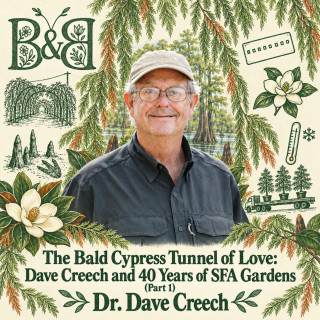
Dave Creech was registering for his second semester of agronomy at Texas A&M when J.B. Storey, a six-foot-four pecan professor, grabbed him in the old basketball coliseum, walked him past every registration table, and introduced him as the next great horticulturist. Dave switched majors. Forty-seven years at Stephen F. Austin State University later, he directs SFA Gardens, 138 acres of mostly bottom land that marks its 40th anniversary this year. In this first of two parts, Ping sits down with a horticulturist she first met as a PhD student at Texas A&M.
His favorite plant is bald cypress, a tree that can last 3,000 years. SFA holds 136 cultivars and selections of it along Lanana Creek. Dave follows one of them, ‘LaNana’, from an unexpected email out of Nanjing Botanical Garden, through USDA quarantine at Beltsville, to 2,000 trees headed for Memorial Park in Houston. Then comes ‘Cascade Falls’, a weeper Dave calls gravitationally challenged. A nursery that couldn’t sell it shipped him several tractor trailers of 12-foot trees, and he trained them over steel pipe into a tunnel where people now propose.
Ping and Dave also compare how China and the United States plant trees, from the tree-lined medians of Chinese highways to weeping willows on every lakeshore, and ask why sweet olive stays a minor crop here when Dave once counted 169 varieties at a single conference. Part 1 ends on February 16, 2021, when SFA went to minus four degrees. Dave spent four days trapped at home, and the Asian evergreen magnolias he had praised on garden tours were later finished off by a nine-degree December night. The plants that made it gave him a new rule for any landscape: 80% natives. Part 2 picks up with Ping’s questions on azaleas, camellias, and Japanese maples.
Listen Time: 53:10 Follow Along with the Transcript
Dr. Dave Creech, Professor Emeritus and Director, SFA Gardens, Stephen F. Austin State University. He taught horticulture in SFA’s Department of Agriculture from 1978 to 2007, retired, and was hired back to direct SFA Gardens. He spent his childhood in India, East Pakistan (now Bangladesh), and Burma (now Myanmar), where his father, an agronomist and former vo-ag teacher, took him along to field plots in Nagpur. He came back to the United States at about 16, moved from agronomy to horticulture at Texas A&M, earned a master’s at Colorado State University on a National Science Foundation fellowship, and finished a PhD in fruit physiology in 1978. His international work has taken him to Guatemala, Mexico, Pakistan, Chile, New Zealand, and, starting in 1994, 27 times to China. Bald cypress is his favorite plant.
Host: Dr. Ping Yu, UGA Department of Horticulture
“I wasn’t a horticulturist, but he made me be one.” Dr. Dave Creech, on professor J.B. Storey (4:28)
“In horticulture, it’s not just fruit and veggie, but also ornamental.” Dr. Ping Yu (10:21)
“Well, in 1,000 years it’ll own your whole lot, your whole home lot.” Dr. Dave Creech, on how big a bald cypress gets (12:49)
“It is gravitationally challenged.” Dr. Dave Creech, on the weeping bald cypress ‘Cascade Falls’ (26:10)
“So now my new mantra with this new wisdom is that, plant 80% of your landscape, and the backbone of it, in natives.” Dr. Dave Creech (51:12)
Three cypresses meet in East Texas. Dave describes East Texas as the place where bald cypress and pond cypress meet, with Montezuma cypress genetics from Mexico to the west. He says Taxodium dubium goes back 90 million years, that the genus was once found around the world, and that it now grows only in North America and Mexico.
Montezuma cypress hardiness. Growers long assumed Montezuma cypress was tropical. In 1983 a young Montezuma cypress at SFA, from an area that rarely freezes, came through a hard freeze unharmed. Dave now grows it in Oklahoma. It is less hardy than some bald cypress, and much hardier than anyone expected.
Knees, or pneumatophores. The knees that rise from bald cypress roots are pneumatophores. Their purpose is still debated. Cutting them off does not slow or kill the tree, but landscapers dislike them because they come up wherever there is moisture and tear up lawn mowers. Chinese breeders were the first to cross bald cypress with Montezuma cypress to get rid of the knees.
Seedlings versus clones. In the United States, 99% of bald cypress are grown from seed, and every seedling is different. Clones, made by grafting or rooted cuttings, are identical. In China and other places, cultivars reproduced by grafting or cuttings are the norm.
Juvenility and cuttings. A cutting roots only from a young plant. Dave’s example is a thousand-year-old bald cypress: take a cutting from it and you cannot root it, because the tree has lost its juvenile ability.
Topophysis and plagiotropic growth. A cutting taken from a side branch “thinks it’s a branch” and keeps growing sideways for a while. That is topophysis, and the sideways habit is plagiotropic growth. The fix Dave learned in China: after one year in a one-gallon can, cut the plant back low, and it will send up a good leader. Those trees can grow six feet the second year.
Training a weeping tree. A weeping bald cypress sends its new growth straight down. To make an arch, Dave tied the plants to bows of steel pipe and left the bows in place for two or three years, until the new growth turned to wood and held its shape.
Two years of establishment. SFA’s standard for a new tree is two or three years of care: keep the weeds away, mulch around the plant, dig a decent planting hole, and water. After that, Dave says, a tree “better learn how to live in East Texas.”
Plant patents and sharing. When SFA Gardens began, universities traded plants freely and academia had no patented trees. Patenting took hold in the 1990s, and people grew nervous about giving away plants bound for royalties. SFA puts patented plants it receives into the garden, but keeps them out of its plant sales.
Why the magnolias died. The February 2021 freeze killed SFA’s Asian evergreen magnolias, some six to eight inches in diameter, back to the trunk, and they regrew fast. A December with no freezes and bananas on the banana plants followed, then nine degrees on December 23rd. That second freeze caught the vigorous regrowth and killed the magnolias. Live oak, native along the Gulf South but not in Dallas-Fort Worth, lost seedling trees when Northeast Texas went to minus eight, minus nine, and minus 11.
Blooms and Beyond explores plant history, culture, and management through the lens of science. Whether you’re a commercial grower seeking practical solutions, a student exploring careers in horticulture, or simply someone who loves plants and their stories, there’s something here for you. Hosted by Dr. Ping Yu of the University of Georgia, each episode features interviews with experts who share enchanting stories, cutting-edge research, and practical wisdom from the world of horticulture.
Your benefit: After each episode, commercial growers will have at least one useful tip for their operation, and plant enthusiasts will have an interesting fact to share. That’s how we spread plant power to more people and make our environment a little better.
Host: Dr. Ping Yu Producer: Rich Braman Guest: Dr. Dave Creech, Professor Emeritus and Director, SFA Gardens, Stephen F. Austin State University
Episode Release Date: September 27, 2026 Episode Length: 53:10
“Till next time, stay healthy and go plants!” 🌱